Places in their life
Explore recorded events and connections, place by place.
Places will load as you reach this section.
Explore places & events
Town and regional markers represent an area. Each record describes the connection to that place.
The life of John Doane “Jack” Wicks
Biography
In the ten years before his death, John Doane Wicks helped turn a three-person operation in an old North Carolina cotton mill into a supplier to major machinery manufacturers. He was still designing filters when an air collision killed him in November 1949. The business he helped establish, WIX, would become an international manufacturer, while an idea attributed to him—the spin-on oil filter—would be developed into a successful product by the engineers who followed him.[1–2]
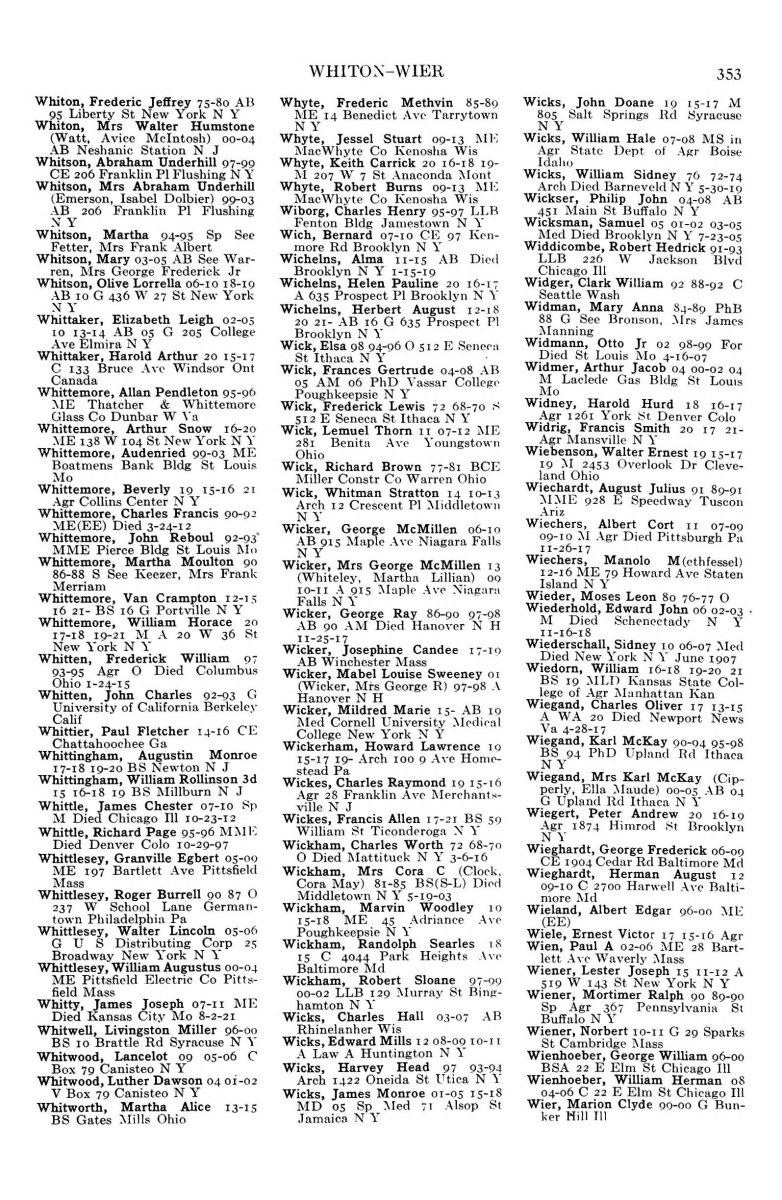
Known as Jack, Wicks was born on July 8, 1896, in Syracuse, New York, to Frederick Stanton Wicks and Lily Moulton Doane. His father practiced law in Syracuse for more than fifty years; his grandfather Edward Bartlett Wicks had been a leather merchant and president of the city’s Mechanics Bank. Jack’s education took a different direction. From 1915 to 1917 he studied mechanical engineering at Cornell University in Ithaca, New York, associated with the class of 1919.[3–4]
By February 1920 he was working as a banker in Syracuse. On February 17 he married Mary Elizabeth Stevens, née Carpenter, in Manhattan, New York City. Mary, known as Libbie, was a widow from Providence, Rhode Island; this was her second marriage and his first. Their family included Marjorie Moulton, John Doane Jr., Sylvia Chamberlain, Barbara Carpenter and Wesley Doane. During the following two decades, family records place Wicks in Syracuse, Poughkeepsie on New York’s Hudson River, and Providence.[3,5]
His path into manufacturing included an unsuccessful business. In the early 1930s he worked for a filter manufacturer, then joined his friend Paul Crawshaw in making and selling candy. When that venture failed, Wicks returned to filters and the development of his own designs. Gastonia, west of Charlotte in North Carolina’s textile country, offered something his product required: cotton waste from the local mills, usable as filtering material.[2]
Wicks and Crawshaw found financial backing from bankers led by Allen Sims. Production began on August 1, 1939, under the name Accessories Corporation, with three employees in an old cotton mill. Sims served as its first president. The enterprise brought together Wicks’s filter work, Crawshaw’s partnership and local capital in a place already equipped to supply a principal raw material.[1–2]
The practical problem was to clean an engine’s circulating oil without obstructing its flow. The filtering element also had to hold together in service and fit securely inside its housing. A design Wicks submitted for a patent in April 1942 enclosed fibrous material in cloth around a perforated central tube. Permanent end washers helped the replaceable element seal against the housing, directing oil through the filtering material. Granted in January 1945 and assigned to Accessories Corporation, the patent made his engineering work part of the company’s assets.[6]
The business developed products for farms as well as roads. Its chronology records agricultural filter refills in 1942 and improved can-type refills in 1944. Its shares began trading over the counter in 1946. By 1949, WIX filters were standard factory equipment for customers including Case, Oliver, Minneapolis-Moline and Diamond T. The company had gained a place in the production of tractors, machinery and trucks, alongside the market for replacement filters.[1]
Wicks’s role extended beyond the drawing board: he served as a company vice president. By 1949 he had been living in Gastonia for about eight years, making his personal settlement there later than the start of production. His early-fifties career combined company leadership with continuing invention.[7]
On January 12, 1949, he applied for a patent on a pleated-paper cartridge. Folding the paper provided more filtering surface within a compact space; shorter auxiliary folds were intended to help prevent the element from buckling. It was a further attempt to make the working filter more effective and dependable. The patent would not be issued until February 3, 1953.[8]
On November 1, 1949, Wicks was aboard Eastern Air Lines Flight 537, travelling toward Charlotte. At approximately 11:46 a.m., as the airliner approached Washington National Airport beside the Potomac River in Arlington, Virginia, it collided with a P-38 flown by a Bolivian military pilot. All fifty-one passengers and four crew members aboard the DC-4 died. The P-38’s pilot survived with serious injuries.[7,9]
The crash ended a marriage of nearly thirty years and left Mary with a family whose youngest child, Wesley, was thirteen. Jack’s grave is recorded at Gaston Memorial Park in Gastonia. Mary survived him until 1992. At the company, his death interrupted an active career: the paper-filter application he had filed that January remained pending, and work on easier filter replacement continued after him.[3,5,8]
Wicks had conceived a spin-on filter, an assembly that could be unscrewed and replaced as a unit instead of requiring the mechanic to handle a separate element inside a reusable housing. During the 1950s, Kingsley Humbert and Paul Francois perfected the design. WIX’s chronology records its acceptance in 1954 and a full-flow spin-on patent in 1955. The simpler replacement operation became a defining part of the company’s reputation.[1–2]
The business grew far beyond the scale Wicks had known. When Dana acquired WIX in 1979, its annual sales exceeded $100 million. By its seventy-fifth anniversary in 2014, WIX reported manufacturing more than 210 million filters a year for customers in over eighty countries. It employed more than 4,500 people worldwide, including 1,500 in the Gastonia area.[2,10]
Those later decades were the work of successive engineers, managers and factory employees, but they grew from the enterprise Wicks and his partners had established. His own contribution joined practical invention to a functioning manufacturer with an expanding market. The collision that ended his life came just as that work was taking hold; the company’s filters carried it into engines and workshops around the world.
Images & documents
Select an image to browse the gallery. Source links open the original records in a new tab.
User-approved person association. Original bytes and source capture retained; portrait authenticity is not inferred.
View source ↗User-approved person association. Original bytes and source capture retained; portrait authenticity is not inferred.
View source ↗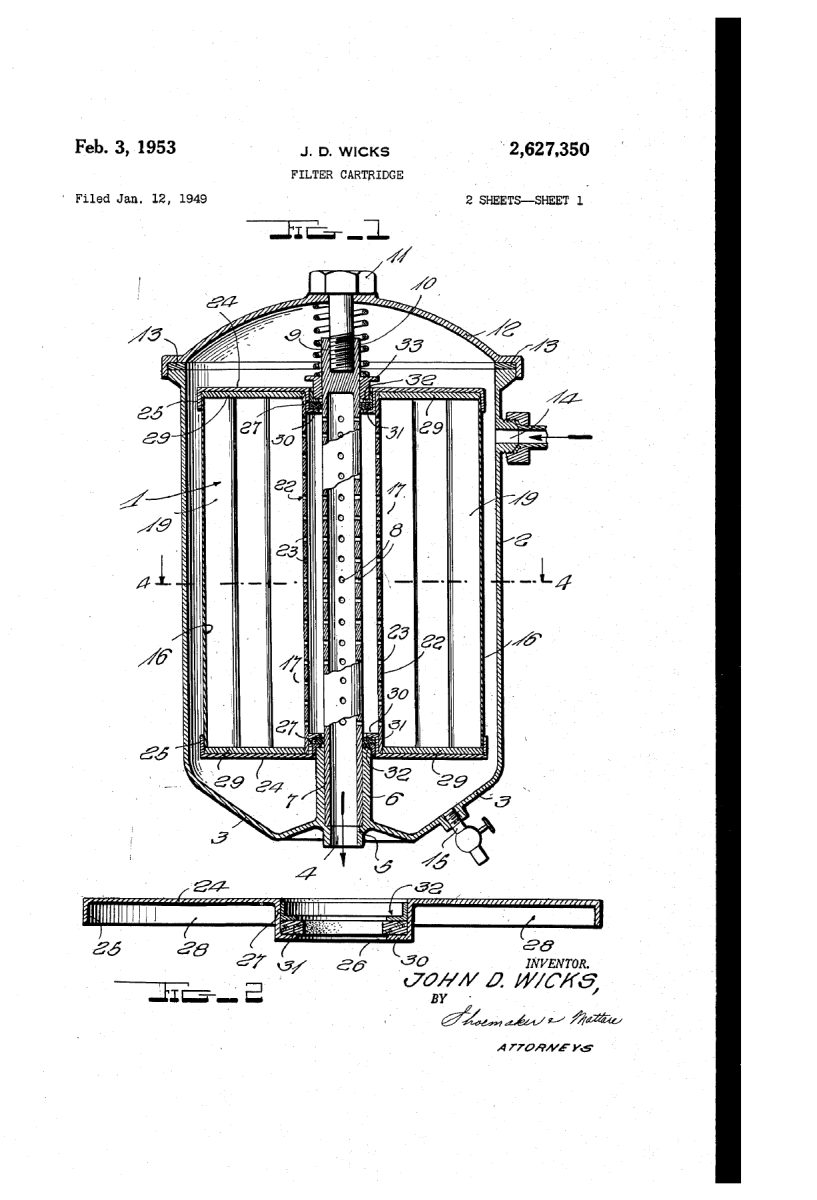
Verified document facsimile; not a portrait or generated reconstruction.
View source ↗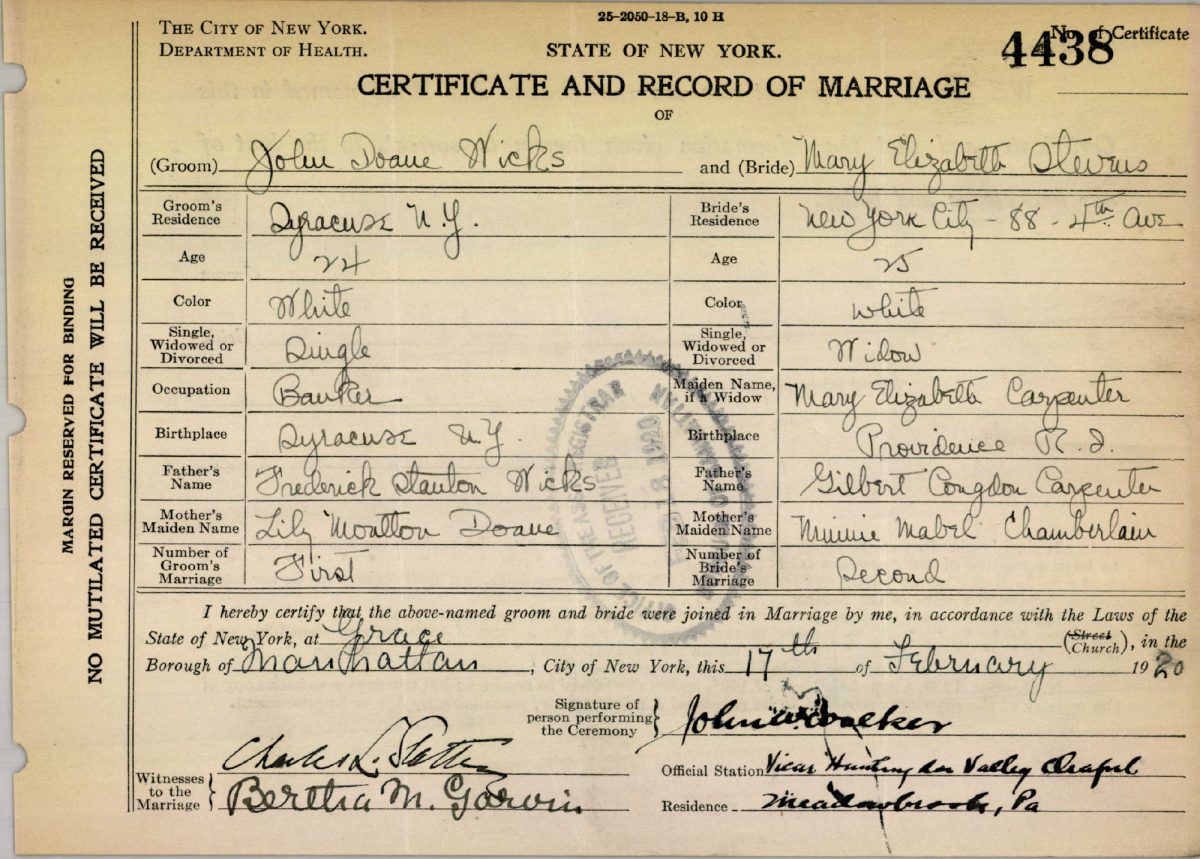
Verified document facsimile; not a portrait or generated reconstruction.
Verified document facsimile; not a portrait or generated reconstruction.
View source ↗
Unaltered official corporate web asset; documented source, not a lifetime photograph of the subject.
View source ↗
Unaltered official corporate web asset; documented source, not a lifetime photograph of the subject.
View source ↗Family relationships
Parents
Full siblings
Children with Mary Elizabeth “Libbie” Carpenter Stevens Wicks
A life in dates
13 events
- Education
Studied mechanical engineering at Cornell University in Ithaca, New York, 1915–1917; class association 1919 is not a degree claim.
Ithaca / Cornell University
Show on map → - Marriage
Married Mary Elizabeth Stevens, née Carpenter, in Manhattan, New York City; he was a banker resident in Syracuse.
Manhattan, New York City
Show on map → - Company Foundation
WIX began production as Accessories Corporation in an old Gastonia cotton mill with three employees. Wicks and Paul Crawshaw were founders; Allen Sims was first president.
Gastonia
Show on map → - Patent Application
Applied for the fibrous filter-element design later issued as US2367745 and assigned to Accessories Corporation.
- Patent Issue
US2367745 issued, naming John D. Wicks as inventor and Accessories Corporation as assignee.
- Patent Application
Applied for the pleated-paper filter cartridge later issued as US Patent 2,627,350.
- Death
Died aboard Eastern Air Lines Flight 537 in the collision near Washington National Airport at approximately 11:46 a.m.
Washington National Airport collision area, Virginia, United States
Show on map → - Posthumous Patent Issue
US Patent 2,627,350 was issued posthumously.
- Burial
Buried at Gaston Memorial Park in Gastonia, North Carolina; the burial date is unknown.
Gaston Memorial Park
Show on map → - Residence
Family records place Wicks in Providence, Rhode Island.
Providence, Rhode Island
Show on map →
More about this person
Other names
John Doane “Jack” Wicks · Jack Wicks
Work & roles
co-founder · WIX Filters
vice president · WIX Filters
Notes & sources
- 1
WIX Filters, Historic Timeline, entries for 1939–1956: founding, initial workforce, Allen Sims, product development, stock trading, factory customers and spin-on milestones.
Back to biography - 2
Dana Corporation, The Story of the Dana Corporation (2004), pp. 94–95, especially the WIX inset on p. 95. The corporate retrospective describes the candy venture, cotton-waste connection and financing, attributes the spin-on idea to Wicks, and names Humbert and Francois as its later developers. The acquisition discussion supplies the 1979 sales figure.
Back to biography - 3
New York City Department of Health, Manhattan marriage certificate 4438 (1920), John Doane Wicks and Mary Elizabeth Stevens, February 17, original image preserved in the research archive; Thomas Minor Society, John Doane Wicks family; grave memorial and photograph. The certificate names Syracuse as his birthplace and gives his occupation as banker. The grave marker gives July 8, 1896; the certificate’s stated age of twenty-four is approximately one year older than that birth date would imply. The date here follows the marker and family chronology; the certificate’s Syracuse identification is preferred to the compilation’s Suffolk entry.
Back to biography - 4
Cornell University, Cornell Alumni Directory (May 15, 1922), p. 353, with explanatory preface and abbreviation key, p. vi. The entry records class association 1919, attendance 1915–1917 and the mechanical-engineering course. Yale University, Obituary Record, 1930–1931, “Frederick Stanton Wicks,” pp. 37–38, for the father’s career and grandfather’s business roles.
Back to biography - 5
Thomas Minor Society, John Doane Wicks family, for residence chronology, Mary’s death and three of the children; DNA Discovery, existing Wicks biography, for the five-child family list and familiar names. The complete family list remains dependent in part on the family account.
Back to biography - 6
John D. Wicks, U.S. Patent 2,367,745, filed April 21, 1942; issued January 23, 1945. Specification, drawings and assignment to Accessories Corporation.
Back to biography - 7
“J. D. Wicks,” The New York Times, November 3, 1949, indexed obituary text identifying him as vice president and a Gastonia resident for eight years. The Gastonia Gazette, November 1, 1949, p. 1, archival summary of the contemporary report, gives his intended Charlotte destination. The earlier Evening Star passenger listing calls him president; the more specific Times obituary supplies the office used here.
Back to biography - 8
John Doane Wicks, U.S. Patent 2,627,350, Filter cartridge, filed January 12, 1949; issued February 3, 1953. This is the pleated-paper cartridge design.
Back to biography - 9
Civil Aeronautics Board, Accident Investigation Report: Eastern Air Lines and P-38 Air Collision, November 1, 1949, opening accident account and history of the flights.
Back to biography - 10
WIX Filters, seventy-fifth-anniversary announcement, August 1, 2014. Production, reach and employment figures are company-reported for 2014.
Back to biography
Family records
- DNA consolidated biography and timeline evidence and decisions
- Location evidence: person 7
- Family history notes