Places in their life
Explore recorded events and connections, place by place.
Places will load as you reach this section.
Explore places & events
Town and regional markers represent an area. Each record describes the connection to that place.
The life of Marie-Madeleine Jarret de Verchères
Biography
Madeleine de Verchères became one of New France’s most celebrated heroines. At fourteen, she helped hold her family’s fort against an attack that threatened everyone sheltering inside. Her story would come to represent the courage and resourcefulness of colonial women. Behind the familiar image of a girl with a musket, however, was a much longer life: daughter, sister, landholder, wife, mother, and determined advocate for her family and herself.
She also belongs to the Jarret family story. Madeleine was a granddaughter of Jean Jarret through his son François Jarret de Verchères. François and André Jarret de Beauregard, whose descendants continued the family line traced here, were half-brothers. That connection would reach directly into the events of Madeleine’s most famous day.[1]
Born on March 3, 1678, Madeleine grew up beside the St. Lawrence River, on its south shore northeast and downstream of Montréal. The settlement bears the same name today: Verchères, in the Montérégie region of Québec, Canada. In her lifetime it belonged to New France, France’s North American colonial territory, whose principal settlements lay along the St. Lawrence. Montréal stood upriver; Québec City lay much farther downstream toward the river’s estuary.
Her father had come to New France as an officer in the Carignan-Salières Regiment and received a seigneurie—a grant of land on which he could establish a settlement and collect dues from the farmers who occupied it. This was the surrounding landed estate; the fort occupied only a small part of it, and today’s municipality of Verchères covers only part of the former seigneury. The name recalled a hamlet near Vignieu and Saint-Chef, in the family’s home district of present-day Isère in southeastern France. Her mother was Marie Perrot. Within the family, Madeleine was known affectionately as Madelon.[2][14]
The fort was her home. Her father had enclosed the household within a wooden stockade that also offered refuge to neighboring settlers. It was a modest enclosure, with high upright timbers, projecting defensive positions called bastions at the corners, and a gate facing the river. Inside stood the family house and a fortified shelter used as a guardhouse and store for weapons and ammunition.
These defenses protected a farming community exposed to war. Verchères lay near routes through which Haudenosaunee forces—called Iroquois in the French accounts—could approach the St. Lawrence settlements. Conflict had already brought grief into Madeleine’s household. Her brother François-Michel had been killed in 1691, and her older sister Marie-Jeanne had lost two successive husbands to attacks.[3]
Madeleine also had an example of resistance close at hand. A later account credits Marie Perrot with helping defend the fort in 1690, during her husband’s absence, with only a few men. Two years later, with both parents away, the daughter would face a similar emergency.[4]
Much of the story comes from Madeleine herself. She first described the defense in a letter written in 1699, seven years after the event. A much fuller narrative followed decades later. The accounts differ in important details, and the longer one contains most of the scenes that made her famous. They preserve how she remembered—and wanted others to remember—her conduct. The narrative below follows that fuller telling, while identifying the best-known detail from the earlier version where the two diverge.[5]
On the morning of October 22, 1692, Madeleine was several hundred paces outside the fort when she heard gunfire. Her father was in Québec City—the colonial capital, at the site of today’s provincial capital—on orders from Louis-Hector de Callière, the governor of Montréal. Her mother was in Montréal, the settlement centred on what is now Old Montréal. Both parents were away from Verchères, in different directions along the St. Lawrence. Settlers outside the enclosure were suddenly under attack.
A servant shouted a warning. Turning, Madeleine saw armed men coming toward her. She ran for the fort.
In her first account, a pursuer came close enough to grasp the scarf at her neck. She escaped, leaving it in his hands. In the later telling, the pursuers stopped and fired when they saw that they could not reach her before she gained the gate. She remembered praying to the Virgin Mary as she ran, the shots making the distance seem interminable.
Within hearing of the fort, she shouted, “To arms! To arms!” She hoped someone would come out to help her. No one did.
At the entrance stood two women mourning their husbands, who had just been killed. Madeleine brought them inside and closed the gate herself. Only then could she consider how to protect the frightened people gathered within.
The stockade was in poor repair. Several timbers had fallen, leaving gaps through which attackers could enter. Madeleine ordered them raised and joined the work, taking hold of one end of a heavy timber and urging the others to lift with her. Before the defenders could hold the fort, they had to close its openings.
She then went to the fortified guardhouse where the ammunition was kept. There she found two soldiers, one lying down and the other holding a burning fuse. When she demanded to know what he intended, he said he wanted to ignite the gunpowder and blow up the fort.
Madeleine ordered him away. She remembered speaking so firmly that he obeyed immediately.
Putting aside her hood, she donned a soldier’s helmet and took up a musket. She called on her younger brothers, Pierre and Alexandre, to stand with her, reminding them of their father’s teachings about service to God and the king.
The brothers and soldiers began firing. Madeleine also ordered the cannon discharged, both to discourage the attackers and to warn soldiers who were away hunting to seek shelter elsewhere. Her earlier account described her loading a cannonball and firing the weapon herself. It also emphasized her efforts to move about in ways that made the small defending force appear larger.
Gunfire did not silence the grief inside the enclosure. Madeleine could still hear people crying for relatives who had been killed or taken. She urged the women to quiet their lamentations, fearing that the sound would reveal the defenders’ distress. She needed those outside to believe the fort was strong, and those inside to believe it could be held.[5]
Then she saw a canoe approaching the riverbank.
Pierre Fontaine was arriving with his wife, Marguerite Anthiaume, and children. These were people connected to Madeleine by family ties. Marguerite was the widow of André Jarret de Beauregard, Madeleine’s uncle, and had remarried earlier that year. Fontaine himself was a corporal in the colonial troops. Bringing them inside would shelter the family and add an experienced soldier to the defense.[6]
They were about to land near the place where Madeleine had narrowly escaped capture. Attackers remained visible outside the fort.
She asked the two soldiers to go to the landing place and protect the family. Neither volunteered. Madeleine therefore instructed the servant Laviolette to guard the open gate and went herself, musket in hand. If she were killed, those inside were to close the entrance and continue the defense.
She later explained the calculation behind this bold appearance. Perhaps the attackers would suspect a trap: a girl walking openly toward the river might be drawing them within reach of soldiers concealed in the fort. That was her explanation for their hesitation; their own reasoning is not recorded.
She reached the family and escorted them toward the enclosure, walking behind them as they passed within sight of the enemy. Once they were inside, she ordered the firing continued.
During the afternoon, another concern drew her attention beyond the walls. Three sacks of linen and some quilts remained outside. While houses were being plundered and burned and cattle killed nearby, she decided to retrieve them.
Again, the soldiers did not respond to her request to accompany her. She turned to her brothers, told them to bring their guns, and ordered those remaining inside to maintain their fire. She described making two trips to recover the goods from the very place where she had nearly been captured that morning.
The episode is among the most extraordinary in her narrative. It also offers a glimpse of the household beneath the military story: the fort contained a family’s home, and even amid danger Madeleine remained concerned with its possessions.[5]
As daylight faded, a northeast wind rose, bringing snow and hail. Madeleine feared that darkness and bad weather would conceal an assault.
She gathered the defenders and arranged the night watch. Fontaine and the two soldiers were to protect the women and children in the strongest shelter. Her brothers took positions on two of the corner bastions. An elderly man, described as eighty years old, watched a third. Madeleine took the fourth.
Across the enclosure, they called assurances to one another. The cries of “All’s well!” carried between the posts through the wind. They signaled vigilance to anyone listening outside and reassured the defenders that their companions were still at their stations.
About an hour after midnight, the man watching the gate heard something.
Madeleine joined him. Through the darkness, helped by light reflected from the snow, she made out cattle approaching the fort. The sentry wanted to let them in. She hesitated, fearing that attackers might be following close behind the animals or using hides as a disguise.
After taking precautions, she agreed to open the gate. Her brothers stood ready with loaded muskets while the cattle entered.
At dawn, Madeleine tried to give the others fresh confidence. They had endured one terrible night, she told them; they could endure another by keeping watch and continuing to fire the cannon for help.
Marguerite Anthiaume was unconvinced. She wanted her husband to take her to the fort at Contrecœur, the neighbouring settlement farther northeast and downstream along the same south shore of the St. Lawrence, now the city of Contrecœur, Québec.[14] Their escape the previous day did not guarantee another. Remaining in such a weakly defended place, she argued, exposed them to death or captivity.
Madeleine’s later account treats Marguerite’s fear dismissively. Yet the woman asking to leave was a recently widowed and remarried mother with children to protect. Her alarm is understandable alongside Madeleine’s determination.
Fontaine offered to prepare a canoe with a sail, saying that the children could help handle it. He himself would stay while “Mademoiselle Magdelon” remained at the fort.
Madeleine paused in her narrative to explain the name: it was what people had called her in childhood. For a moment, the celebrated heroine becomes Madelon again, the girl known to this family.
She answered that she would not abandon the fort.[5]
The remaining days receive less detailed treatment. There is no complete daily record of assaults and responses. Instead, Madeleine describes continued alarms, watchfulness, and the effort to sustain a small company until help arrived.
She recalled twice going twenty-four hours without food or rest. She stayed at her post and checked the fortified shelter rather than retiring to her father’s house. In front of the others, she deliberately maintained a cheerful appearance and encouraged them with the prospect of relief.
According to this later account, help arrived during the night on the eighth day.
Madeleine was dozing with her head on a table and her musket across her arms when a sentry heard voices on the water. She climbed to a bastion and challenged the approaching party.
The answer identified them as French soldiers. Lieutenant de La Monnerie had come with forty men sent by Callière.
Madeleine had the gate opened, left a sentry to guard it, and went down to the river to receive them. She recalled saluting the officer and offering to surrender her arms to him.
He replied that they were in good hands.
“Better than you think,” she answered.
After he inspected the defenses, she asked him to relieve her sentries so that they could rest. Her account ends the vigil with that practical request: the people who had held the posts needed sleep.[5]
The fort’s survival became the defining event of Madeleine’s life. Its familiar eight-day duration and many of its dramatic episodes, however, depend on her later narrative. The earlier letter is shorter and describes a smaller defending force. These differences matter. They remind us that the defense and the increasingly elaborate story through which it became famous are not entirely the same thing.
Madeleine took an active part in seeking recognition. Her 1699 letter appealed to the Comtesse de Maurepas, wife of the minister responsible for the colonies. She asked for a pension or, failing that, an officer’s commission for one of her brothers. She also pointed to women in France who had resisted invasion, arguing that Canadian women could show the same devotion.
Her request combined personal pride, family need, and an assertion that women’s service deserved reward.[5]
After her father’s death in 1700, she was granted his annual pension of 150 livres, with the obligation to provide for her mother. She helped care for the family and estate until her marriage in 1706. Her younger brother Pierre pursued a military career; in 1708 he died during the French and Indigenous expedition against Haverhill, then an English colonial settlement and now a city on the Merrimack River in northeastern Massachusetts, in the United States. The boy who had helped defend his own settlement was killed taking war into another.[3][4][14]
Madeleine married Pierre-Thomas Tarieu de La Pérade at twenty-eight. He was a lieutenant in the troupes de la Marine, France’s regular colonial troops, administered through the ministry responsible for the navy and colonies. These soldiers served on land in New France’s garrisons and campaigns.[2][7]
The couple settled at Sainte-Anne-de-la-Pérade, on the north shore of the St. Lawrence between Trois-Rivières and Québec City, where her husband held part of the seigneurie. The community retains that name today. It lies at the mouth of the Sainte-Anne River, roughly fifty kilometres northeast of Trois-Rivières, in Québec’s Mauricie region. Madeleine had moved well downstream from Verchères and to the opposite side of the St. Lawrence. The historic parish and seigneury preceded the modern municipality; the shared name connects these places across time without making their boundaries identical. The couple had five children. Her adult responsibilities now included a household, children, property, and the sometimes difficult relationships between landholders and the people living on their estates.[2][8]
That household also participated in slavery. A notarized transaction dated June 15, 1709, records her husband’s purchase of Pascal, an Indigenous man about nineteen years old, for 120 livres. His presence belongs in the family’s history alongside its military achievements and social standing: the household in which Madeleine lived held another person in bondage.[9]
Her later years were also marked by disputes. The most damaging involved Gervais Lefebvre, a priest who had formerly served as the family’s spiritual adviser. Accusations concerning his conduct developed into litigation. A judgment initially favorable to the couple was reversed in December 1730, leaving them responsible for legal costs.
In 1732, Madeleine crossed the Atlantic to pursue the matter in France. She returned the following year without securing the reversal she sought. A settlement in October 1733 released the couple from obligations to the priest and required both sides to cease their accusations. It brought an expensive quarrel to an end, but did not give her the court victory she had wanted.[10]
Her willingness to undertake that journey in her fifties gives the adult Madeleine a place beside the girl at the fort. The causes were different, but the record again shows a woman prepared to act, argue, and persist on her household’s behalf.
Madeleine was buried at Sainte-Anne-de-la-Pérade on August 8, 1747, aged sixty-nine.[2]
Her reputation continued to change after her death. Later writers made her a model of religious devotion, patriotic sacrifice, female courage, and domestic virtue. Joseph Marmette’s 1880 retelling expanded the storm into a theatrical scene and called her a model housekeeper when she recovered the linen. Even a girl commanding armed men could be presented as fulfilling an ideal of womanly duty.[11]
In 1913, Louis-Philippe Hébert’s great monument gave that reputation a commanding presence beside the St. Lawrence. A film followed in 1922, adding a romantic role for her future husband to a story whose documented marriage lay fourteen years beyond the defense. Each generation found something it wanted in Madeleine and reshaped her accordingly.[12]
The family’s military story continued as well. Madeleine’s sister Angélique was the mother of Louis Coulon de Villiers, who commanded the force that compelled George Washington to surrender Fort Necessity in present-day Pennsylvania in July 1754. Madeleine had been dead seven years, but another member of the family had entered an event with consequences far beyond the St. Lawrence valley.[13]
Madeleine’s own story remains most compelling among the people inside the wooden walls: her brothers at their posts, her aunt fearing for the children, Fontaine refusing to leave, and Madeleine trying to appear cheerful while waiting for help. Her recollections gave those moments a heroic shape. They also preserved something more intimate—the effort of a young girl to keep a household and a frightened company together when their safety depended on what they did next.
Images & documents
Select an image to browse the gallery. Source links open the original records in a new tab.
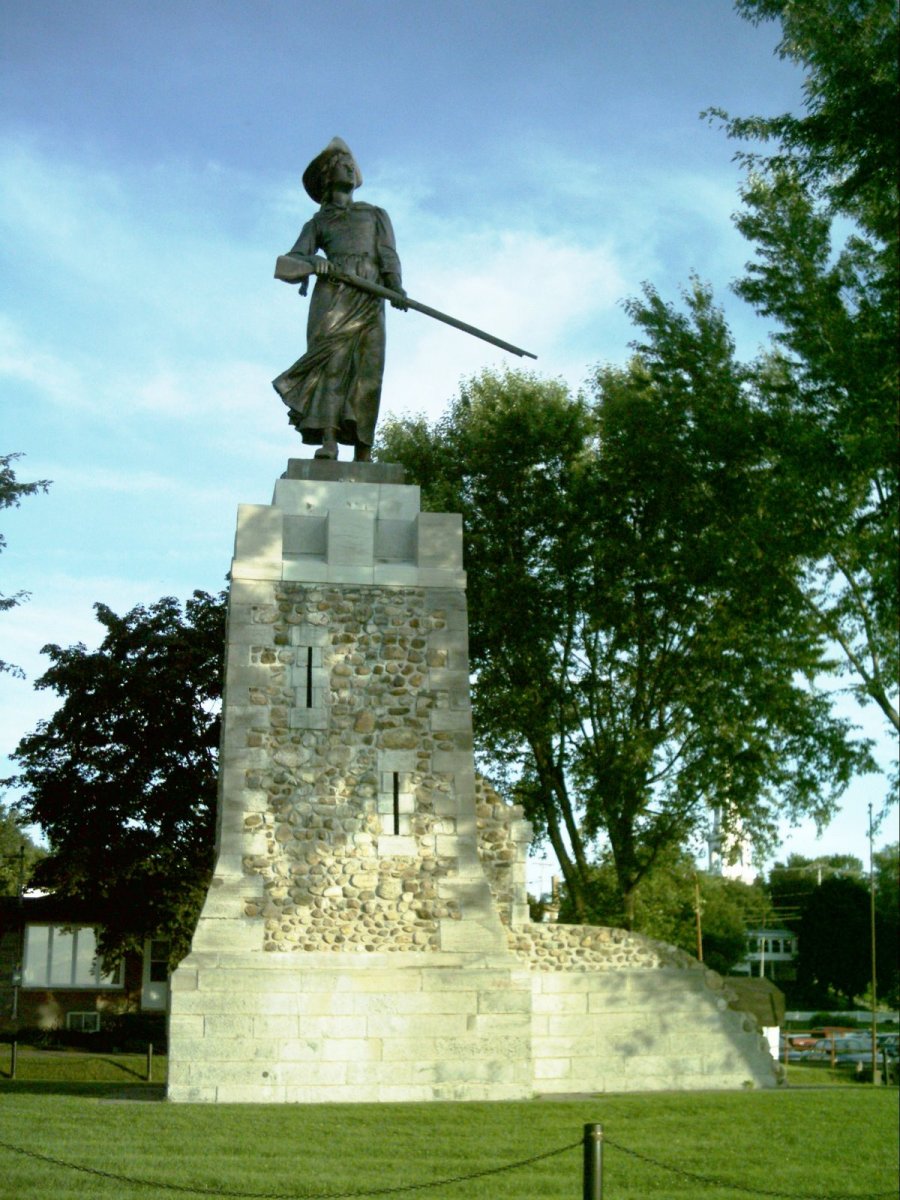
User-uploaded original, approved submission 74 review 1 for person 853. Photograph of a sculpture depicting Madeleine de Verchères; not a photograph of the historical person. Original photographer and license not supplied.
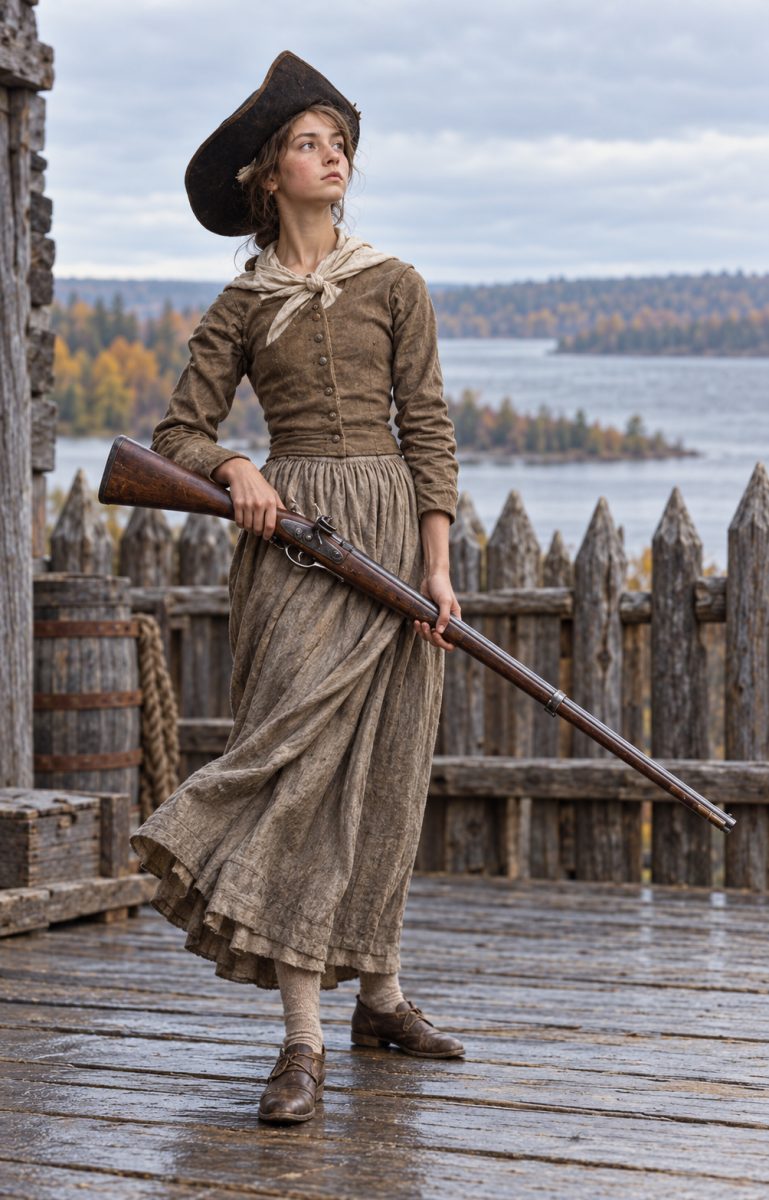
User-uploaded original, approved submission 74 review 1 for person 853. Illustrative reconstruction; generation method and likeness not authenticated.
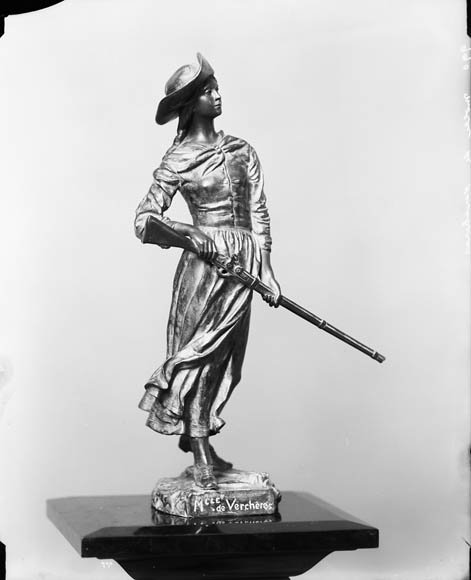
User-uploaded original, approved submission 74 review 1 for person 853. Photograph of a sculpture depicting Madeleine de Verchères; not a photograph of the historical person. Original photographer and license not supplied.
Family relationships
Parents
Full siblings
Children with Pierre-Thomas Tarieu de La Pérade
A life in dates
17 events
- Connection to this place
Birth household and pension — Verchères.
Verchères, Québec, Canada
Show on map → - Baptism
Baptism recorded in the Sorel register; the register location is not assumed to be the place of birth.
Saint-Pierre parish, Sorel, Québec, Canada
Show on map → - Fort Defense
Beginning of the defense described in Madeleine’s accounts; its detailed eight-day narrative is retrospective.
Fort de Verchères, Québec, Canada
Show on map → - Correspondence
Wrote to the Comtesse de Maurepas seeking recognition for the defense.
Verchères, Québec, Canada
Show on map → - Pension
Received her late father’s pension with an obligation to support her mother.
- Marriage
Married Pierre-Thomas Tarieu de La Pérade.
- Residence
Established her married home at Sainte-Anne-de-la-Pérade.
Sainte-Anne-de-la-Pérade, Québec, Canada
Show on map → - Connection to this place
Married home and burial — Sainte-Anne-de-la-Pérade.
Sainte-Anne-de-la-Pérade, Québec, Canada
Show on map → - Marriage Contract
Marriage contract with Pierre-Thomas Tarieu, Michel Lepailleur de La Ferté.
- Litigation
A judgment in the dispute with Gervais Lefebvre was reversed.
- Legal Settlement
Settlement ended the dispute with Gervais Lefebvre.
- Burial
Buried at Sainte-Anne-de-la-Pérade.
Sainte-Anne-de-la-Pérade historical parish, Québec, Canada
Show on map →
More about this person
Other names
Madeleine de Verchères · Madelon · Magdelon · Marie-Magdelaine Jarret
Notes & sources
- 1
Fichier Origine, entries for François Jarret de Verchères and André Jarret de Beauregard. These establish the family connection through Jean Jarret.
Back to biography - 2
Répertoire du patrimoine culturel du Québec, “Jarret de Verchères, Marie-Madeleine”. For her childhood name, see her later narrative in note 5, printed page 10.
Back to biography - 3
André Vachon, “Jarret de Verchères, Marie-Madeleine,” Dictionary of Canadian Biography. Used for the fort, regional vulnerability, family losses, pension, and assessment of the differing narratives.
Back to biography - 4
Céline Dupré, “Jarret de Verchères, Pierre,” Dictionary of Canadian Biography. Covers Marie Perrot’s earlier defense, Pierre’s participation with Madeleine and Alexandre, and his death in the Haverhill expedition.
Back to biography - 5
Supplement to Dr. Brymner’s Report on Canadian Archives, 1899, published in Ottawa in 1901. Madeleine’s earlier letter begins on printed page 6; her longer narrative begins on printed page 7, with the fort-defense story continuing through printed page 11. Dialogue follows this published English translation and represents Madeleine’s recollection, not a contemporaneous transcript. The longer narrative’s heading gives 1696, an erroneous date; the defense is conventionally dated October 22, 1692.
Back to biography - 6
Société de généalogie de Québec, Les familles pionnières de la Nouvelle-France dans les archives du Minutier central des notaires de Paris, entry for Marguerite Anthiaume; and the transcription of her April 13, 1692, marriage contract with Pierre Fontaine, identifying him as a corporal in Louvigny’s company. The children in the canoe are not individually named in Madeleine’s narrative.
Back to biography - 7
Canadian Museum of History, “Wars and Imperial Rivalries,” Virtual Museum of New France.
Back to biography - 8
Municipality of Sainte-Anne-de-la-Pérade, municipal history; MRC de Marguerite-D’Youville, heritage account of Madeleine de Verchères, for the couple’s five children.
Back to biography - 9
Christina Dickerson, Diplomats, Soldiers, and Slaveholders, p. 115, discussing the notarized purchase of Pascal.
Back to biography - 10
- 11
Joseph Marmette, “Mademoiselle de Verchères,” Héroïsme et Trahison (1880). Used as evidence of how the story was later told, rather than as independent confirmation of the events of 1692.
Back to biography - 12
Répertoire du patrimoine culturel du Québec, “Monument de Madeleine de Verchères”; Colin Coates, “Madeleine de Verchères,” in Women Warriors and National Heroes, for the film and the changing uses of her reputation.
Back to biography - 13
Dictionary of Canadian Biography, entries for Nicolas-Antoine Coulon de Villiers and Louis Coulon de Villiers; National Park Service, “Battle of Fort Necessity”.
Back to biography - 14
Modern geographic context: Commission de toponymie du Québec, Verchères, including the distinction between the former seigneury and modern municipality and the French origin of the name; Ville de Contrecœur, municipal history; City of Haverhill, History and Heritage. For Sainte-Anne-de-la-Pérade’s location and successive parish and municipal boundaries, see the municipal history in note 8.
Back to biography
Family records
- Madeleine collateral research — ACCOUNT
- Madeleine collateral research — G1
- Madeleine collateral research — LITIGATION
- Madeleine collateral research — M
- Madeleine collateral research — A
- Madeleine collateral research — C
- Madeleine collateral research — N
- Madeleine collateral research — N4
- Madeleine collateral research — N5