Places in their life
Explore recorded events and connections, place by place.
Places will load as you reach this section.
Explore places & events
Town and regional markers represent an area. Each record describes the connection to that place.
The life of Capt. James Jones
Biography
Life summary. Captain James Jones helped manage Weston’s meetinghouse construction and finances and held interests in outlying Massachusetts townships. His 1753 will joined provision for his wife Sarah and descendants with obligations attached to extensive property. He died in 1770, nearly seventeen years later.
James Jones took responsibility for Weston’s meetinghouse construction and town finances. He was named among those acting for the town in a meetinghouse construction agreement in 1720, served as selectman and treasurer in 1721, and joined the committee charged with covering and enclosing the new meetinghouse in 1722. These were connected responsibilities: an institution needed materials and labor, and the town needed people to account for their cost. 601-1
Weston, west of Boston in present-day Massachusetts, had become a separate town in 1713. Its farms lay at a distance from Watertown’s older meetinghouse. Developing a local religious and civic center reduced that separation for a dispersed population. James’s building and financial responsibilities belonged to the practical formation of this local center. 601-3601-4
Born on September 4, 1679, he married Sarah Moore of Sudbury. Their family included eleven children. His property interests reached beyond Weston to Narragansett Township No. 6, later associated with Templeton and much of present-day Phillipston in north-central Massachusetts. An original proprietor, he served on a committee concerned with laying out lots in 1735. His work as a proprietor extended his interests beyond his home community. 601-2
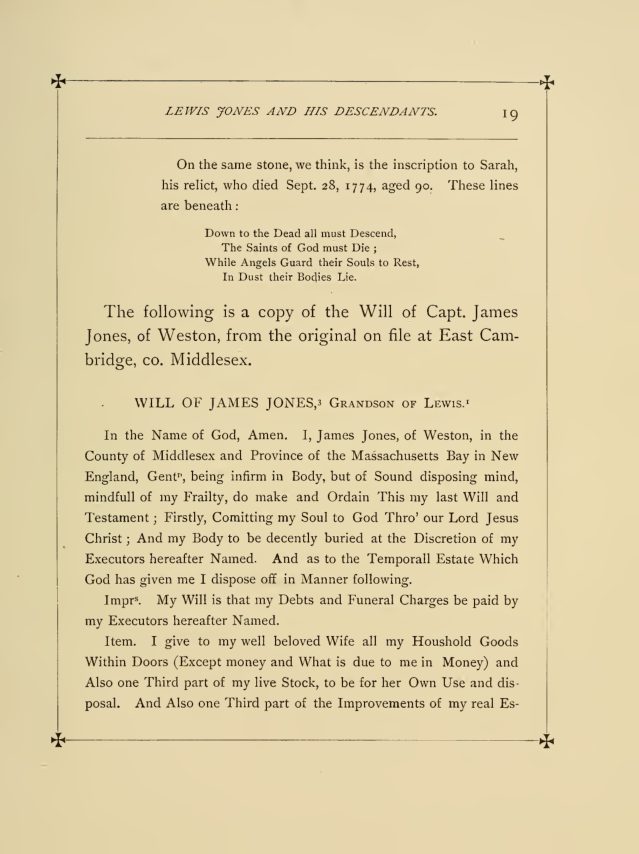
When he made his will on November 20, 1753, James dealt with a family already divided among several households and generations. His eldest son James was assigned twenty shillings in addition to land already received. Seven children of his deceased daughter Sarah Robinson were each to receive forty shillings, the boys at twenty-one and the girls at eighteen or marriage. Lydia’s four Jones children were each assigned £5 under similar age or marriage conditions. The will directed portions toward grandchildren whose circumstances differed from those of his surviving children. 601-2
He also left £7 each to Solomon and Sarah, children of his eldest son James. The will linked some portions to earlier gifts, distributing what remained after years in which family members had already received support. 601-2
Aaron and Isaac were assigned extensive property interests carrying substantial obligations. Aaron’s clause refers to a share of James’s mansion house, barn and homestall; Isaac’s refers separately to the house in which Isaac then lived. Both clauses refer to deeds dated October 19, 1753. Their portions also included meadow and outlying lands, with lots 5 and 99 respectively in Narragansett No. 6. Together they were charged with debts, legacies and funeral expenses. 601-2
Sarah’s provision was different. Household goods, with exceptions for money and debts owed to James, and a third of the livestock were assigned for her use and disposal. She was also to enjoy a third of the use or income of real estate and buildings while she remained his widow. The settlement thus combined resources she could dispose of with continuing support from property passing through the estate. 601-2
Other land lay at Paquoiagg, in the historical Athol area of Massachusetts. The will’s geography extended well beyond the family’s home town, but its obligations repeatedly returned to the support of particular people. James lived nearly seventeen more years, dying in September 1770. The published family account and reported gravestone inscription differ by a day; the will was presented for probate on 23 October. The plan presented for settlement had been written long before his death, bringing together household support, family legacies and land interests in several communities. 601-2
Images & documents
Select an image to browse the gallery. Source links open the original records in a new tab.
Boston Public Libraryscanvia Internet Archive
View source ↗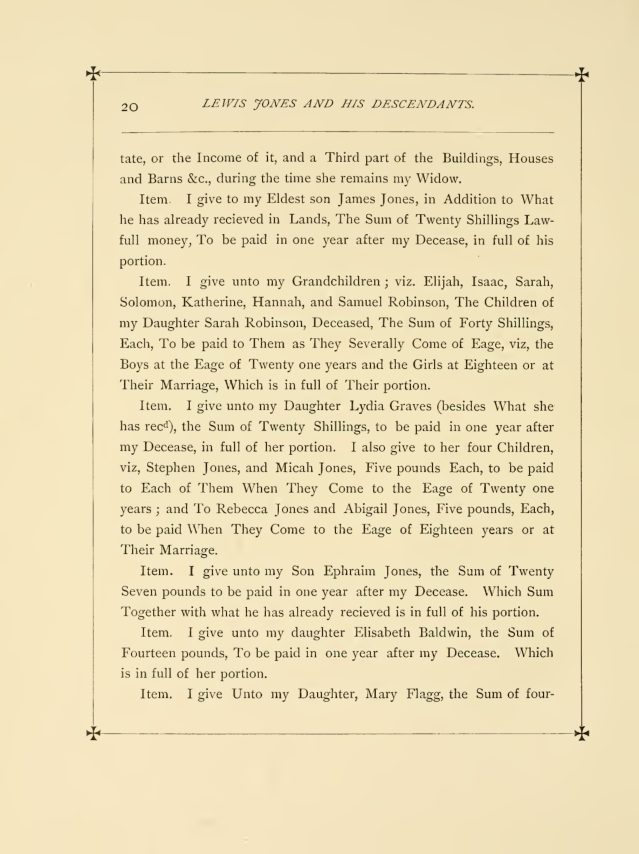
Boston Public Libraryscanvia Internet Archive
View source ↗Family relationships
A life in dates
8 events
- Connection to this place
Household, civic work and will — Weston, Middlesex, Massachusetts.
Weston, Middlesex, Massachusetts
Show on map → - Meetinghouse Committee
Joined Weston’s committee to cover and enclose its new meetinghouse.
Weston, Middlesex, Massachusetts
Show on map → - Property Committee
Named to a committee for laying out lots in Narragansett Township No.6, later Templeton and much of Phillipston. This establishes a property role, not residence.
Templeton
Show on map → - Will
Made a will allocating property and obligations among children and distinguishing Sarah’s disposable goods and livestock from conditional use of real estate during widowhood.
Weston, Middlesex, Massachusetts
Show on map → - Death
James Jones died in September 1770. The published family list gives September 14 and the reported epitaph September 15; both claims are retained.
Weston, Middlesex, Massachusetts
Show on map → - Probate Presentation
Aaron and Isaac Jones presented their father James’s will for probate.
Weston, Middlesex, Massachusetts
Show on map →
More about this person
Other names
Capt. James Jones (1679–1770)
Notes & sources
- 601-1
Daniel S. Lamson, History of the Town of Weston, Massachusetts,1630–1890 (1913), pp 40–42,163:1720 agreement and 1721–22 town responsibilities.
Back to biography - 601-2
William Blake Trask, Some of the Descendants of Lewis and Ann Jones (1878), family chronology pp 17–30; will pp 19–23; dower pp 53–55. Published transcriptions; original manuscripts were not inspected.
Back to biography - 601-3
Weston Historical Commission, Boston Post Road District statement of significance, Watertown Farms, meetinghouse and colonial economy. Unreliable stagecoach date excluded.
Back to biography - 601-4
Congregational Library & Archives, Weston First Parish records introduction.
Back to biography
Family records
- DNA consolidated biography and timeline evidence and decisions
- Lewis Jones descendants and Watertown/Weston records — Capt. James Jones family