Places in their life
Explore recorded events and connections, place by place.
Places will load as you reach this section.
Explore places & events
Town and regional markers represent an area. Each record describes the connection to that place.
The life of Rose Trippe
Biography
Life summary. Rose Trippe Hammond Steward held property rights at Lavenham that continued to affect her family after her son William moved to New England. Her lifetime use of land, estate responsibilities and later succession linked English property with efforts by a grandson to obtain possession.
Rose Trippe retained the use of English land for her lifetime, even after her son William Hammond left for New England. When his affairs became entangled in bankruptcy, her prior right still governed possession: according to a later lawsuit, commissioners could not take the Lavenham land into present possession while she held it. Her own security had consequences for the next generation across the Atlantic. 696-1696-2
Rose had married Thomas Hammond at Lavenham, Suffolk, on May 14, 1573. Thomas worked as a shearman in the town’s cloth economy. Their children included Elizabeth, William and four other daughters named in his will. When he prepared that will in October 1589, he provided Rose with lifetime use of a house, fields and access lanes. He appointed her sole executrix, responsible for the estate’s settlement, and left her its residue after debts and legacies. 696-3696-4
The house occupied by Thomas Westlie and Great Lyverdowne were ultimately to pass to William; Little Lyverdon had a separate succession involving Elizabeth. 696-3
Rose remarried after Thomas’s death and became known as Rose Steward. She also held rights in property derived through her own family. It was this separate inheritance that became the subject of the later litigation involving William. 696-1696-2696-3
She made her own will on November 10, 1633, remembering Elizabeth Livermore and members of the Hammond and Livermore families. The litigation account places her death in 1645; probate of her will followed on June 27, 1649. Her estate thus reached probate several years after her reported death. 696-1696-2
According to the retained published reconstruction, William authorized his son Thomas in 1647 to seek possession of Rose’s former Lavenham land. Whether the effort succeeded remains uncertain, but the commission carried her property’s history into action by a grandson. Rose’s English estate remained part of the family’s affairs across both distance and generations. 696-1696-2
Images & documents
Select an image to browse the gallery. Source links open the original records in a new tab.
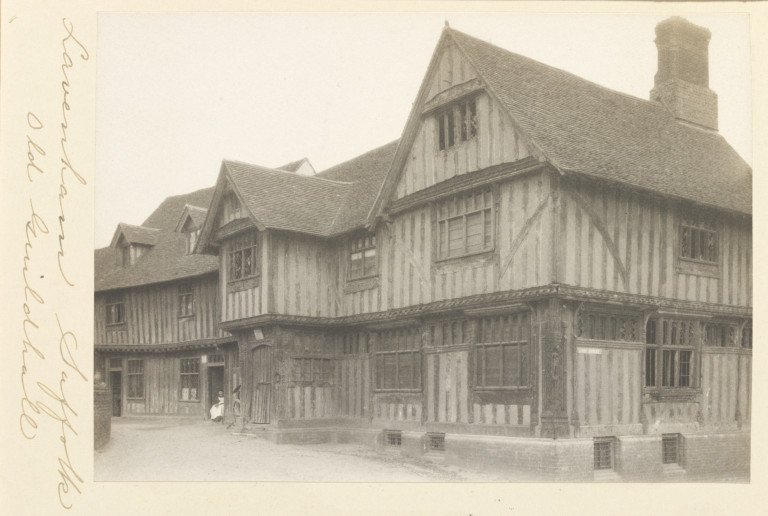
Victoriaand Albert Museum, object O 56508; museumdigitalimage; Commonsmetadata
View source ↗Family relationships
A life in dates
3 events
- Connection to this place
Households, life interest and will — Lavenham, Suffolk, England.
Lavenham, Suffolk, England
Show on map → - Will
Rose Steward made her will, remembering Elizabeth Livermore and members of the Hammond and Livermore families.
Lavenham, Suffolk, England
Show on map → - Probate
Rose Steward’s will was proved, several years after her reported 1645 death.
Notes & sources
- 696-1
Miller-Anderson Histories, William Hammond, Great Migration-derived passages citing Watertown 1:10,14,47,66; Middlesex probate 2:88–93, case 10262; Hotten 279; Aspinwall 112. Mediated historical extracts; the underlying manuscripts were not independently inspected.
Back to biography - 696-2
Cybergata, William Hammond, reproducing the English litigation account in NEHGR 106:83–84. Departure-year differences remain unresolved.
Back to biography - 696-3
Frederick Stam Hammond, History and Genealogies of the Hammond Families in America (1902–1904), pp 50–52, Thomas Hammond’s 1589 will, reproduced on WeRelate. The will clauses are used; incompatible surrounding pedigree/date claims are not adopted.
Back to biography - 696-4
Little Hall, Lavenham and the Cloth Trade, production stages, especially fulling, raising and shearing. Occupational process, not evidence of a particular workshop.
Back to biography
Family records
- DNA consolidated biography and timeline evidence and decisions
- Robert Charles Anderson — The Great Migration Begins: William Hammond