Places in their life
Explore recorded events and connections, place by place.
Places will load as you reach this section.
Explore places & events
Town and regional markers represent an area. Each record describes the connection to that place.
The life of Thomas Hammond
Biography
Life summary. Thomas Hammond was a shearman in Lavenham, Suffolk, finishing woollen cloth for sale. His 1589 will combined provisions for his wife Rose with future interests for their children, connecting his trade, household goods and land to the family’s continuing support.
Thomas Hammond worked at a demanding stage of cloth production: turning a raised, uneven woollen surface into finished fabric. A shearman handled cloth over a board and trimmed it with large shears. The material had already passed through spinning, weaving and fulling before it reached this finishing work. Thomas’s skill belonged to a chain of specialized labor that made Lavenham, in Suffolk in eastern England, a cloth-producing town. 695-1695-2
He married Rose Trippe there on May 14, 1573. Their children included Elizabeth, William, Rose, Martha, Marie and Susanna. Alongside his trade, Thomas held property whose future use required careful arrangements: a house, fields and the lanes connecting them. 695-1
When Thomas made his will on October 2, 1589, he arranged for Rose to use a house occupied by Thomas Westlie, the field called Great Lyverdowne and the lanes needed to reach it for the rest of her life. William was to receive those holdings afterward. The will expressly protected a route for driving and carrying through Little Lyverdon to Great Lyverdowne. Rose’s use of the field therefore included the access needed to work it; both field and route were afterward to pass to William. 695-1
A second field, Little Lyverdon, was also assigned for Rose’s lifetime. Elizabeth was to succeed to this field and its lane. If she outlived Rose, both were to pass to her and her heirs; if she died before Rose without children, the will redirected the lane to William. 695-1
Daughters Rose, Martha, Marie and Susanna were each to receive forty shillings when they reached twenty-one. Those deferred portions placed the younger women’s provision on a different footing from the lifetime use of land given to their mother. 695-1
Thomas also remembered his sister Margaret Jollye with a feather bed and a ship chest. Rose was appointed sole executrix and was to receive what remained after debts and legacies. Her appointment entrusted her with settling claims on the estate and the children’s portions while retaining the property rights assigned for her own support. 695-1
The will was proved on December 11, 1589. Thomas had arranged for resources from his working life to support Rose immediately, while the children’s access to their portions depended on age, survival and her prior rights. 695-1
Images & documents
Select an image to browse the gallery. Source links open the original records in a new tab.
User-approved person association. Original bytes and source capture retained; portrait authenticity is not inferred.
View source ↗User-approved person association. Original bytes and source capture retained; portrait authenticity is not inferred.
View source ↗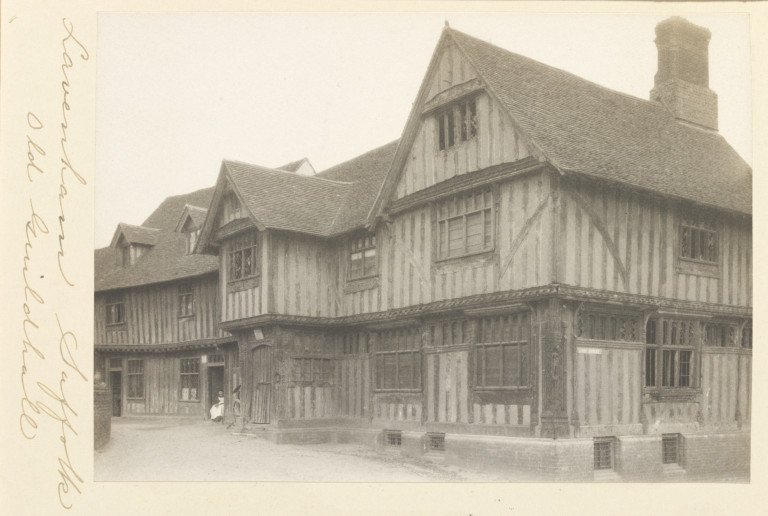
Victoriaand Albert Museum, object O 56508; museumdigitalimage; Commonsmetadata
View source ↗Family relationships
A life in dates
3 events
- Connection to this place
Cloth-finishing household and estate — Lavenham, Suffolk, England.
Lavenham, Suffolk, England
Show on map → - Connection to this place
Burial association — Lavenham parish churchyard.
Lavenham parish churchyard
Show on map → - Will
The Lavenham shearman provided Rose with lifetime use of a house and fields, with different later rights for William and daughter Elizabeth.
Lavenham, Suffolk, England
Show on map →
Notes & sources
- 695-1
Frederick Stam Hammond, History and Genealogies of the Hammond Families in America (1902–1904), pp 50–52, Thomas Hammond’s 1589 will, reproduced on WeRelate. The will clauses are used; incompatible surrounding pedigree/date claims are not adopted.
Back to biography - 695-2
Little Hall, Lavenham and the Cloth Trade, production stages, especially fulling, raising and shearing. Occupational process, not evidence of a particular workshop.
Back to biography
Family records
- DNA consolidated biography and timeline evidence and decisions
- Location evidence: person 695
- Robert Charles Anderson — The Great Migration Begins: William Hammond