Places in their life
Explore recorded events and connections, place by place.
Places will load as you reach this section.
Explore places & events
Town and regional markers represent an area. Each record describes the connection to that place.
The life of William Hammond
Biography
Life summary. William Hammond moved from Lavenham to Watertown, Massachusetts, while English bankruptcy and inheritance matters remained unresolved. In Massachusetts he held scattered lands, served the town and arranged lifelong estate use for his wife Elizabeth before their son’s eventual possession.
William Hammond’s move to New England did not end his involvement with English property. A later lawsuit describes bankruptcy proceedings and land at Lavenham that could not be taken into present possession while his mother, Rose, retained its use for life. Years after his departure, William was still trying to secure possession through the next generation. Migration changed where he lived; it did not erase the family’s earlier rights and obligations. 693-1693-2
William was baptized at Lavenham, Suffolk, on October 30, 1575, a son of Thomas Hammond and Rose Trippe. He married Elizabeth Paine there on June 9, 1605. Their English household grew before their migration to Massachusetts. The litigation account dates his bankruptcy to February 1629/30 and describes a departure in November, although surviving retellings differ over the departure year. His precise voyage remains uncertain. 693-1693-2693-3
In Watertown, west of Boston, William acquired a holding made up of separated parcels. One land inventory gives a thirty-four-acre home lot, meadow and upland, and a hundred-and-fifty-six-acre farm. Another gives the home lot as forty acres. The entries describe the holding at different points in its history. 693-4
Access linked these pieces of land. A town order in the first month of 1640 provided for a cartway through William’s lot and neighboring land, allowing hay to be brought from Rock Meadow and more distant meadows. Hay was useful where the animals were kept, so the route made outlying resources available to the home farm. Timothy Hawkins’s ten-acre home lot adjoined Hammond land, placing the two families near one another as well as within a wider network of shared routes. 693-4693-5
The published extracts of town records place William in civic work, including service as a selectman in 1647 and arbitration with Isaac Stearns. Those duties involved governing the town and helping settle disputes among its inhabitants. 693-1
His English claim remained active that year. In 1647, according to the retained published reconstruction, he authorized his son Thomas to seek possession of Rose’s former Lavenham lands. The commission records an attempt to obtain the property; its outcome remains uncertain. 693-1693-2
In 1656 William helped assign seats in the meetinghouse. Four years later, town officials challenged his admission of an unnamed person to his own household. They feared a burden on public support and directed him to remove that burden or bear the cost. The order made the practical question of who would maintain another person a matter of town concern. 693-1
William’s will of July 1662 gave Elizabeth use of his estate for life, with houses and land afterward passing to their son John. The reported inventory included an orchard, pasture, meadow, cultivated land, a share of a barn and books. William died at Watertown on October 8, 1662. As in the English property arrangements that had affected him, the next generation’s possession was subject to a surviving woman’s prior lifetime right. 693-1
Images & documents
Select an image to browse the gallery. Source links open the original records in a new tab.
User-approved person association. Original bytes and source capture retained; portrait authenticity is not inferred.
View source ↗
User-approved person association. Original bytes and source capture retained; portrait authenticity is not inferred.
View source ↗User-approved person association. Original bytes and source capture retained; portrait authenticity is not inferred.
View source ↗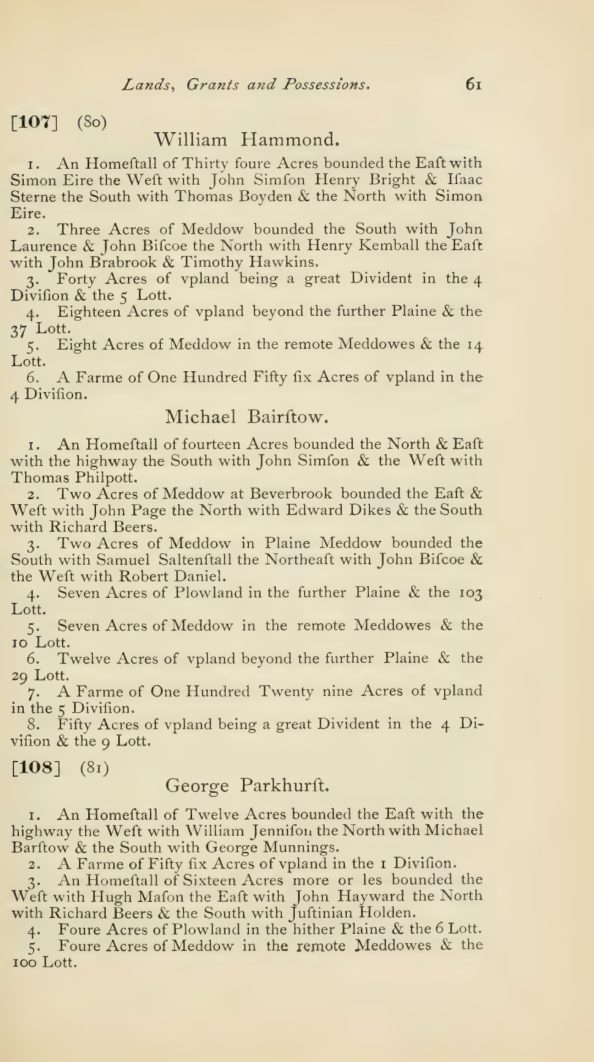
Watertown Records (1894), saved public-domain scan; upstream item watertownrecords 01 wate
View source ↗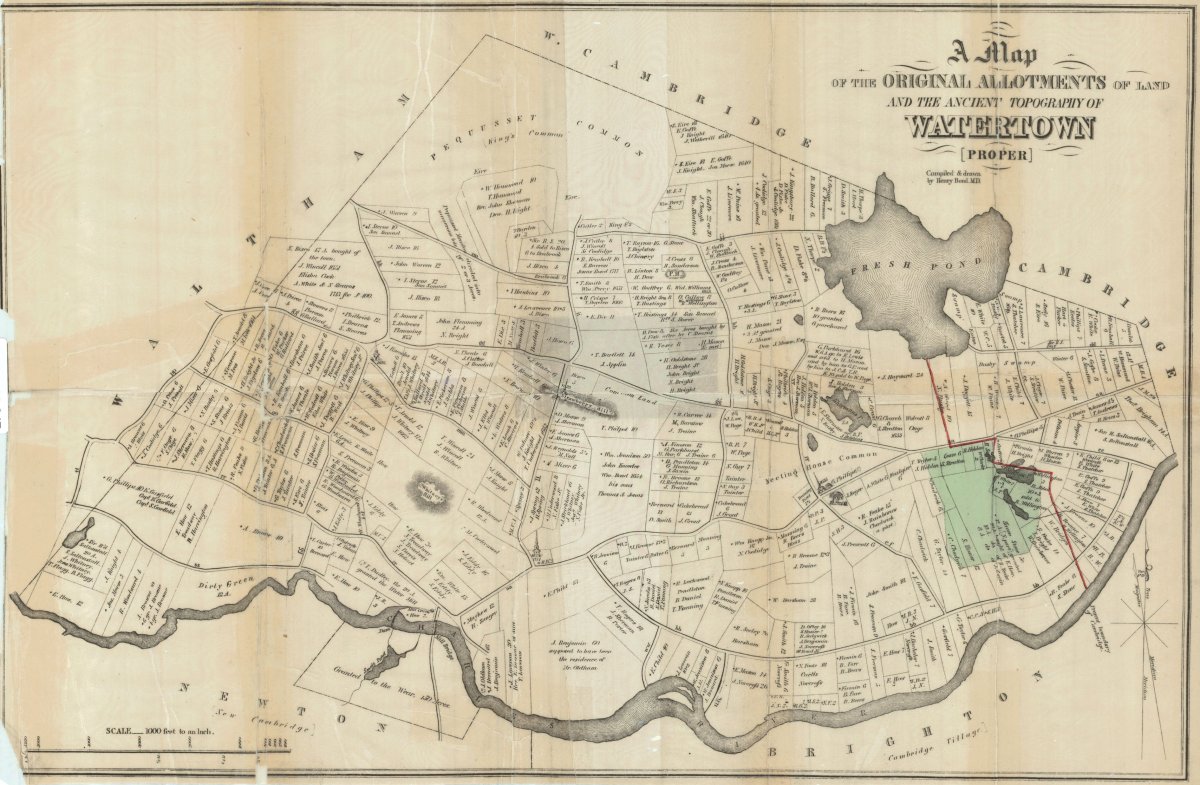
Birmingham Public Library, p15099coll3:746
View source ↗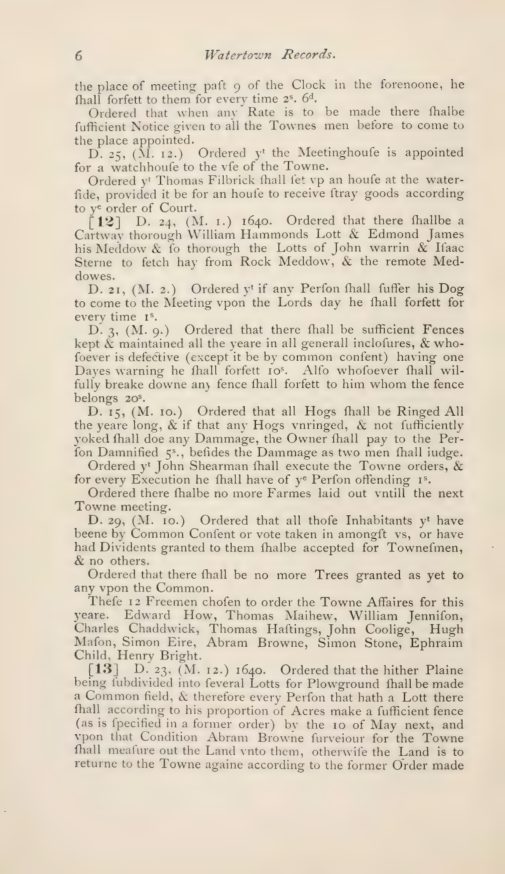
Watertown Records (1894), public-domain scan, Internet Archive
View source ↗Family relationships
Parents
Children with Elizabeth Paine
A life in dates
12 events
- Property Access Order
A town order provided a cartway through William Hammond’s lot and neighboring land for fetching hay from Rock Meadow and more distant meadows.
Watertown, Middlesex, Massachusetts
Show on map → - Property Authorization
Authorized son Thomas to seek possession of Rose’s former Lavenham lands after her death. The claim’s eventual outcome is unknown.
- Public Office
Served as a Watertown selectman, according to the account.
Watertown, Middlesex, Massachusetts
Show on map → - Meetinghouse Duty
Helped assign seats in Watertown’s meetinghouse.
Watertown, Middlesex, Massachusetts
Show on map → - Household Order
Four years after the 1656 seating work, town officials directed William to remove a potential public-support burden from his household or bear its cost.
Watertown, Middlesex, Massachusetts
Show on map → - Will
Gave Elizabeth use of his estate for life, with houses and land afterward passing to their son John.
Watertown, Middlesex, Massachusetts
Show on map → - Reported Bankruptcy
A later English lawsuit dates William Hammond’s bankruptcy to February 1629/30; departure-year retellings conflict.
- Reported Departure
William Hammond reportedly left England in November, but published retellings disagree over the year. No particular ship or exact route is established.
England
Show on map → - Connection to this place
Baptism, marriage and English property — Lavenham, Suffolk, England.
Lavenham, Suffolk, England
Show on map → - Connection to this place
Settlement, civic work and death — Watertown, Middlesex, Massachusetts.
Watertown, Middlesex, Massachusetts
Show on map →
Notes & sources
- 693-1
Miller-Anderson Histories, William Hammond, Great Migration-derived passages citing Watertown 1:10,14,47,66; Middlesex probate 2:88–93, case 10262; Hotten 279; Aspinwall 112. Mediated historical extracts; the underlying manuscripts were not independently inspected.
Back to biography - 693-2
Cybergata, William Hammond, reproducing the English litigation account in NEHGR 106:83–84. Departure-year differences remain unresolved.
Back to biography - 693-3
Frederick Stam Hammond, History and Genealogies of the Hammond Families in America (1902–1904), pp 50–52, Thomas Hammond’s 1589 will, reproduced on WeRelate. The will clauses are used; incompatible surrounding pedigree/date claims are not adopted.
Back to biography - 693-4
Watertown Records, vol. 1 (1894), separately paginated sections: land inventories, pp. 34, 61, 108, 146; town proceedings, p. 6.
Back to biography - 693-5
Massachusetts Historical Commission, Watertown reconnaissance survey (1980), printed pp 2–3, settlement and economy. General setting, not evidence of individual activities.
Back to biography
Family records
- DNA consolidated biography and timeline evidence and decisions
- Robert Charles Anderson — The Great Migration Begins: William Hammond