Places in their life
Explore recorded events and connections, place by place.
Places will load as you reach this section.
Explore places & events
Town and regional markers represent an area. Each record describes the connection to that place.
The life of Capt. Benjamin Swett
Biography
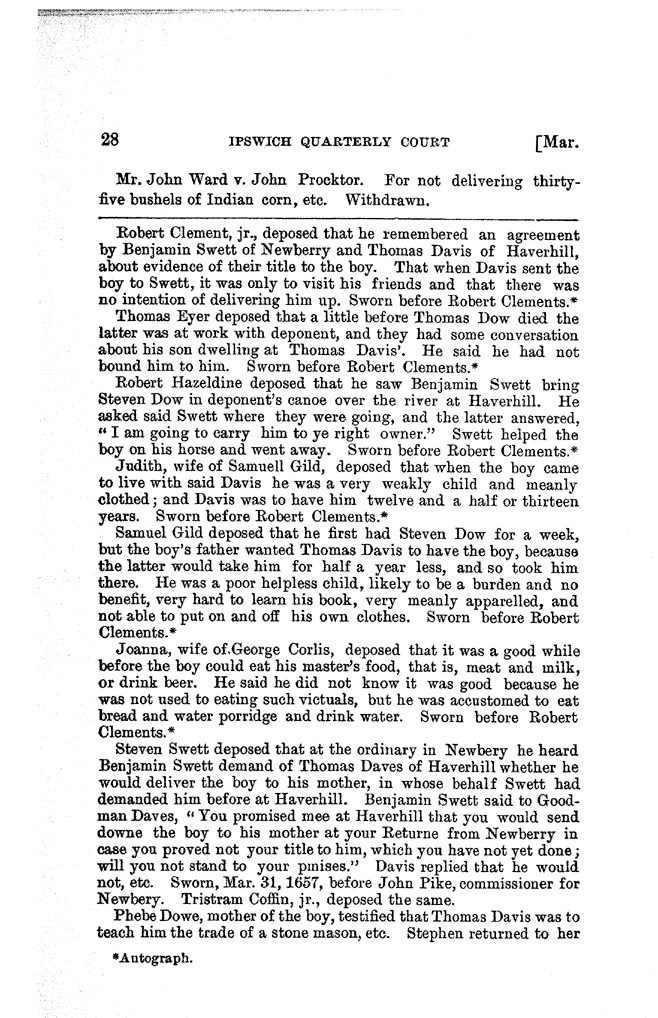
In 1657 Benjamin Swett brought a boy across the river at Haverhill in Robert Hazeldine’s canoe, helped him onto a horse, and went away with him. Stephen Dow’s mother wanted her son back from the household in which his father had placed him. Swett acted on her behalf. The man claiming Stephen’s service took Swett to court, and the court ordered the boy returned. Benjamin had contested another man’s authority over a dependent child and acted before the dispute had been settled.1
From Norfolk to Newbury
Benjamin was baptized on May 12, 1624, at Wymondham, an inland town in Norfolk in eastern England. His parents were John Swett and Phebe Benton, who had married at nearby New Buckenham on April 24, 1604. John served as a local inspector of leather in New Buckenham, an occupation he later resumed in Massachusetts. Benjamin grew up among several siblings, including Stephen and Joseph, who would also appear beside him in Newbury’s affairs.2
John had settled at Newbury by 1642. Benjamin probably accompanied the family to this Massachusetts Bay town near the mouth of the Merrimack River. By June 1648 he had married Hester Weare, daughter of Nathaniel Weare, and their first child, also Hester, had been born. More children followed: Sarah, Mary, a second Mary, Benjamin, Joseph, and Moses during their Newbury years. The first Mary apparently died before the second was born in 1654. Seven births over thirteen years brought repeated demands of childbirth, care, and provision into the household.3
On December 7, 1648, his brother Stephen found Thomas Smith, a boy of about twelve, dead in a pit on Newbury’s common. Benjamin sat on the jury called to investigate. After hearing witnesses who had seen the boy on his way to school and at the pit, the jurors concluded that he had fallen in accidentally.4
Benjamin acquired public responsibilities while the family was growing. He was admitted a freeman on September 24, 1650, gaining a recognized place among the colony’s political members. On October 14, 1651, the General Court confirmed his election as ensign, a junior officer in Newbury’s militia company. The town had held a new election because its previous choice had been unclear. Local selection and colonial approval both mattered to his appointment.5
His property dealings included both land and credit secured on a crop. On May 22, 1650, Henry Dove acknowledged owing Benjamin and Robert Long sixty bushels of merchantable wheat, due at their houses by October 19. Dove pledged the land he rented from Mr. Spencer and the corn growing on it, retaining the right to work and harvest it until payment fell due. In June 1651 Benjamin bought ten acres of Newbury upland from John Spenser and conveyed the same parcel to Edmond Moores three days later.6
The courts called on him as a juror, witness, and appraiser, but he also appeared as a defendant. At Hampton on October 4, 1653, Nathaniel Winsley brought a debt claim against him for a small cask of sack, a wine, valued at about £3. The court took no action on the claim. Benjamin’s dealings also included helping to value the estate of Newbury minister James Noyes in 1656 and a disputed animal in 1657: practical judgments about property were part of his public work.7
In 1653 the government punished Robert Pike of Salisbury for criticizing restrictions on preaching. Pike lost his political rights and was fined. Benjamin and his brothers Stephen and Joseph joined other Newbury residents in petitioning for relief. When commissioners demanded an explanation, Benjamin defended a free subject’s liberty to petition on behalf of a respected person. He did not withdraw his position. On November 1, 1654, the General Court ordered him and several other petitioners summoned, each under a £10 bond to answer for the alleged offense. The government treated their petition as a challenge to its judgment; Benjamin treated petitioning as a legitimate act.8
Around 1655 Benjamin and his brother-in-law Nathaniel Weare took a seven-year lease of John Woodbridge’s Newbury farm. They lived there and worked the land until about 1661 or 1662. A spring used as a watering place lay inside the farm’s fence, along with a small strip claimed by people asserting rights through the neighboring Pike property. The tenants used both. The partnership thus involved more than raising crops: access to water and the practical limits of the land they occupied could themselves become disputed property.9
Claims over children, and plans for land
Stephen Dow’s case brought several kinds of household authority into conflict. His father, Thomas Dow, had placed him with Thomas Davis of Haverhill, farther up the Merrimack from Newbury. Witnesses described an arrangement lasting until Stephen was eighteen, in which Davis would maintain him and teach him reading, writing, and stone masonry. Other testimony said the father had declined to bind the boy formally because Davis was too occupied with other work to teach him the trade. By the time of the dispute, Thomas Dow was dead and his widow, Phebe, wanted Stephen with her.1
Benjamin demanded that Davis establish his right to retain Stephen or release him to his mother. Davis maintained that a visit to Swett’s household had been permitted, not a permanent departure from his service. Robert Hazeldine saw Benjamin ferry Stephen across the river at Haverhill in Hazeldine’s canoe and help him onto a horse. Phebe testified that Stephen had returned to her and wished to stay, but that Davis pulled him away violently. The question was not simply where the boy preferred to live: it was whether his father’s arrangement gave Davis an enforceable claim to his work and upbringing.1
Several witnesses defended Davis’s household, describing adequate food, warm clothing, and instruction from his wife. One said Benjamin had refused an offer to submit the dispute to impartial arbitrators. At the Ipswich court session beginning March 31, 1657, Davis prevailed: Stephen was ordered returned. Davis also acknowledged his obligation to teach the boy to read and write and to train him as a stone mason according to his capacity and the opportunities of the place. The proceeding recorded Davis’s obligations while upholding his claim to Stephen’s service.1
Benjamin’s own household responsibilities extended to his widowed mother, Phebe. On April 14, 1658, he and Hester sold John Woolcutt a Newbury house with seven acres of arable land, an orchard, barn, garden, and cow yards, together with six acres of marsh or meadow, for £80. Woolcutt already occupied the property. The sale reserved Phebe’s right to live in the bakehouse and come and go freely for four years. If she chose to leave sooner, Woolcutt could take it over immediately; otherwise his unrestricted possession would begin when the term expired. The provision protected a place for her while allowing Benjamin and Hester to dispose of the larger property.10
In February 1658/9 Benjamin probably joined another petition, this time concerning one of his own children. A group of inhabitants asked the Ipswich authorities to investigate John Godfrey, whom they suspected of causing extraordinary losses and afflictions after disagreements with them. Benjamin Swet was named in connection with his child. The petition sought official inquiry into what the families regarded as unnatural harm.11
Meanwhile Benjamin and Nathaniel Weare joined a proposal to establish a new English town at Pennacook, inland on the upper Merrimack in the vicinity of present-day Concord, New Hampshire. The petitioners sought a tract twelve miles on each side, three years to decide whether to proceed, and seven years free of public charges if they settled. On May 18, 1659, a committee of the General Court recommended a smaller grant, eight miles on each side—sixty-four square miles. The accepted conditions required a decision by October 1660 and the settlement of twenty families within two years thereafter. Those conditions were not fulfilled, and the grant was forfeited. Benjamin’s participation remained an unsuccessful settlement venture.12
In May 1660 he traveled to Nantucket, the island south of Cape Cod, where he and Weare were at Thomas Macy’s house during negotiations over an Indigenous girl’s service. An Indigenous intermediary called Mr. Harry asked John Bishop whether he wanted a girl to live with him. Bishop wanted ten years. Benjamin and Weare later testified that, after repeated consultation among the Indigenous participants, the girl, Mall, agreed to five years, with another five only if she wished to remain.13
That account of consent was contested. Mall subsequently came into the care of John Hathorne at Lynn, on the Massachusetts coast northeast of Boston, after being found on the road toward Boston. Hathorne resisted Bishop’s attempt to recover her. Speaking on Mall’s behalf, he challenged the interpreter’s accuracy and Harry’s authority, described her as about sixteen, and said her mother had neither known of nor consented to the arrangement. Mall herself denied agreeing to it. Benjamin and Weare swore their testimony at Ipswich on September 25, 1660; the court ordered Mall returned to Bishop. In Stephen Dow’s case Benjamin had challenged a household’s claim to a child. In Mall’s, his testimony supported the account on which a contested claim to service rested.13
Hampton
Around 1662 or 1663 Benjamin and Hester moved north from Newbury to Hampton, settling in the part of the town now called Hampton Falls. Hampton lay on the New Hampshire coast but was then governed within Massachusetts Bay’s old Norfolk County. Four more children were born there: Hannah in 1664, Elizabeth in 1667, John in 1670, and Stephen in 1673. Across the two towns, Hester had borne eleven recorded children over twenty-five years. They were not all children living together at one time; the eldest daughter married in 1668, five years before Stephen’s birth.14
Benjamin’s property included rights in Hampton’s common pasture. By 1670 he had conveyed to Samuel Tilton, a Hampton carpenter, a share of the cow common previously purchased from Richard Swaine. He reserved his interest in two shares if land within the town’s ring of commonage should later be divided. A common share was a right in collectively used land, and reserving a future division kept a property interest beyond the immediate sale.15
His military title had advanced to lieutenant by April 12, 1664, when he served as foreman of a trial jury at Salisbury. That October he sat on the grand jury at Hampton, which considered accusations for prosecution. He also served as a Hampton selectman in 1666, 1670, and 1675–1676, helping to conduct the town’s affairs. These duties placed him repeatedly among neighbors deciding questions of property, conduct, and local government.16
The enforcement of judgments could draw on the same practical knowledge. In January 1670/1 Benjamin and John Partridge appraised land tendered by Henry Greenland in proceedings involving Walter Barefoot’s debt to Harlackendine Symonds. Later that year, a lawsuit involving Benjamin, Abraham Drake, and Henry Green against Barefoot and Greenland produced an October 10 order to seize Barefoot’s property at Kittery Point, across the Piscataqua River from Great Island, now New Castle, and two thousand feet of Greenland’s pine boards. The court’s reach extended across the coastal settlements, turning claims into orders against land and goods.17
Benjamin also participated in a remonstrance dated May 31, 1671, objecting to the General Court’s appointment of Robert Pike as sergeant-major of the county. This time Pike benefited from the government’s choice. The objection concerned who should choose the military officer: the people or the colonial court. Benjamin’s earlier defense of Pike and his later opposition to the appointment both involved the limits of authority.18
The eastern war
War brought more immediate responsibilities. In 1675 a man known as Goodman Robinson was killed while traveling from Exeter toward Hampton; his son escaped and reached Hampton with the news. The next day Lieutenant Swett led a dozen townsmen into the woods to search for Robinson and found his body. The danger lay on the approaches to Benjamin’s own community.19
That winter he helped raise and conduct recruits for the Narragansett campaign, directed against the Narragansett people in what is now Rhode Island. He was probably attached to Captain Joseph Gardiner’s company during the campaign that culminated in the attack on the fortified Narragansett settlement on December 19, 1675, commonly called the Great Swamp Fight. By January 17, 1675/6 he was organizing men for the continuing campaign. Orders sent recruits under him and directed Captain Daniel Fisher at Dedham, southwest of Boston, to arrange their movement onward. On February 1 the council authorized an allowance of £3 for him.20
King Philip’s War, named for the Wampanoag leader Metacom whom the English called Philip, continued in the eastern settlements after the main fighting in southern New England had subsided. Along the coast of present-day Maine, communities depended on fortified houses and garrisons while attacks disrupted farms and travel. Swett commanded the garrison at Wells, northeast of Hampton, in the spring of 1677. On April 29 he sent eleven soldiers out after an Indigenous man appeared nearby. The party encountered an ambush: two soldiers were killed and a third mortally wounded. Swett responded by sending help. The relief force reportedly shot five or six opponents before they withdrew. A small apparent opportunity outside the garrison had exposed his men to a prepared attack.21
The eastern war involved distinct Indigenous communities and competing alliances. Men from Christian Indigenous communities in Massachusetts served with the English, including men from Natick, west of Boston, and the Wamesit community of the Merrimack valley. Their opponents included forces associated with Squando, a leader in the Saco and Androscoggin region. The English settlements’ desire for protection existed alongside Indigenous grievances over disarmament, imprisonment, broken agreements, and interference with subsistence and trade. These divisions would shape the expedition Swett was about to command.22
Four Hampton men were killed on June 13, 1677. Later that month Massachusetts commissioned Swett as captain of English and Indigenous forces sent east, with authority over the expedition’s vessels and crews. His instructions, issued at Charlestown on June 22, directed him to Black Point, a coastal settlement in present-day Scarborough, Maine. He was to establish the opposing forces’ position, consult Major Thomas Clarke and people familiar with local conditions, and attack if an opportunity justified it. Otherwise he was to work southward behind the settlements of Winter Harbor, Wells, and York toward the Piscataqua, replacing garrison soldiers and distributing troops where they were needed.23
Lieutenant James Richardson had separate orders for a force including Indigenous allies to scout between the Merrimack and Piscataqua rivers. His instructions offered twenty shillings for an enemy scalp and forty for a prisoner. The expedition combined the relief of threatened settlements with scouting and orders that rewarded taking captives and killing opponents.24
Before Benjamin departed, he spoke to Seaborn Cotton and Anthony Stanyan about Hester’s future. He wanted her to have enough to maintain herself comfortably and to help her children without depending on them for her own support. At home, those children ranged from a married daughter to Stephen, still only three.25
Black Point and the household afterward
Swett’s expedition reached Black Point by sea on June 28, 1677. It included men with little preparation for an extended campaign. That very day, Concord’s militia officers petitioned for the return of four young men who had been sent out for a short scouting duty and then carried on toward Black Point; the officers considered them unfit for the service now expected of them.26
On the morning of June 29, scouts reported opposing fighters nearby. Swett advanced with a force of roughly ninety to one hundred English and Indigenous soldiers, including local men. His opponents drew the advancing force into an attack, and its formation broke under fire. Richardson was killed. Swett tried to keep his men together and bring away wounded and dead soldiers as the withdrawal deteriorated. Repeatedly wounded himself, he was killed near the garrison. Dozens of English soldiers and Indigenous allies died with the two commanders.27
The defeat exposed the danger of advancing hastily with inexperienced troops. Swett’s efforts during the retreat could not repair the collapse of his force. The fighting also continued amid attempts at negotiation. A message from Moxes and other Kennebec leaders, received in Boston on July 1, sought peace and renewed trade, complained of English violations of agreements, and distanced its authors from the Androscoggin fighters. They accused Squando of seeking captives to strengthen his own position in negotiations. The communities facing the English were pursuing different aims in the aftermath of the fighting at Black Point.28
Hester received authority to administer Benjamin’s estate on October 9, 1677. Its inventory valued the property at £558 19s., an assessment of the estate rather than a sum of ready money. On March 29, 1678, Cotton and Stanyan gave sworn testimony about Benjamin’s wishes for her support. The family settlement followed on April 9.29
The eldest son, Benjamin, accepted land and a young horse as his double portion—the larger share allotted to him as eldest son. Eight other children were assigned £30 each, payable as they came of age in goods at inventory valuation or corn at the prevailing country price. The settlement therefore provided for nine children as beneficiaries. The estate was to remain in Hester’s hands for her and the children, with responsibility for paying their portions; what remained at her death after those payments was to be at her disposal.30
Hester married Stephen Greenleaf on March 31, 1679, about twenty-one months after Benjamin’s death. She entered that marriage with an estate settlement that joined provision for herself to obligations toward her children: land and a horse for the eldest son, eight promised portions, and the work of administering what Benjamin had left.31
Images & documents
Select an image to browse the gallery. Source links open the original records in a new tab.
Verified document facsimile; not a portrait or generated reconstruction.
View source ↗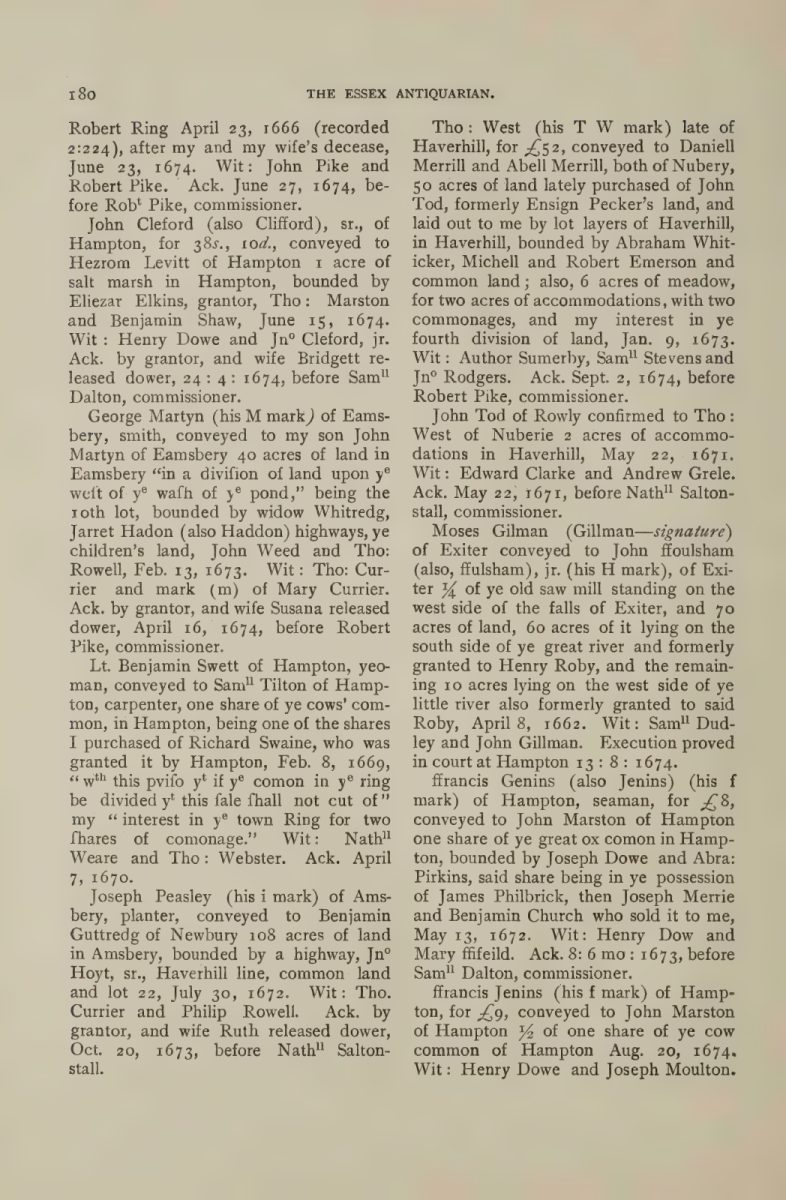
Verified document facsimile; not a portrait or generated reconstruction.
View source ↗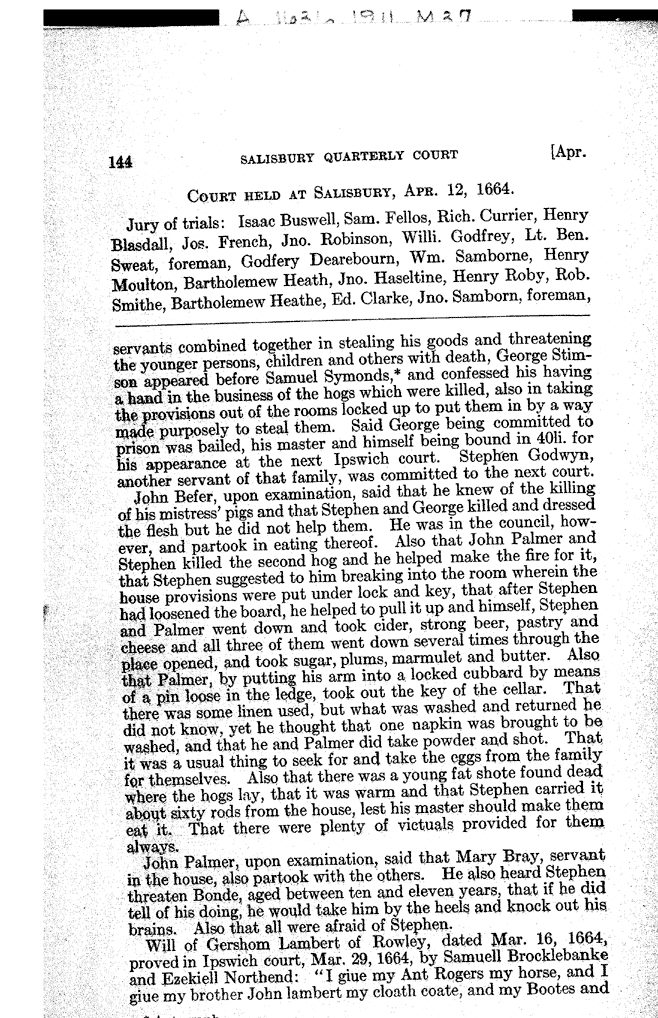
Verified document facsimile; not a portrait or generated reconstruction.
View source ↗Family relationships
A life in dates
18 events
- Civic Status
Admitted a freeman at the Ipswich court session.
Ipswich, Essex, Massachusetts
Show on map → - Militia Commission
The General Court confirmed his election as ensign in Newbury’s militia company.
- Court Case
Ipswich session began hearing Thomas Davis’s claim to Stephen Dow’s service; the court ordered Dow returned. The canoe episode at Haverhill preceded the proceeding.
Ipswich, Essex, Massachusetts
Show on map → - Property Conveyance
Benjamin and Hester sold Newbury property to John Woolcutt for £80, reserving his mother’s right to lodge in the bakehouse for four years.
Newbury, Essex, Massachusetts
Show on map → - Visit
Visited Thomas Macy’s house on Nantucket during the disputed negotiations over Mall’s service.
Nantucket, Massachusetts, United States
Show on map → - Testimony
Swett and Nathaniel Weare swore testimony concerning Mall at Ipswich.
Ipswich, Essex, Massachusetts
Show on map → - Migration
Moved with Hester and their children from Newbury to Hampton’s Falls district, now Hampton Falls, New Hampshire, about 1662 or 1663.
Hampton Falls district
Show on map → - Jury Service
Served as trial-jury foreman at Salisbury and was styled lieutenant by this date.
Salisbury, Massachusetts
Show on map → - Military Service
Probably served with Captain Joseph Gardiner’s Narragansett campaign in December 1675. His individual participation in the Great Swamp assault remains uncertain.
- Military Service
Commanded the Wells garrison during the sortie and ambush; sent relief after two men were killed and a third mortally wounded.
Wells, York, Maine
Show on map → - Arrival
Arrived at Black Point by sea with the expedition.
Black Point (Scarborough), Maine, United States
Show on map → - Battle
Commanded English and allied Indigenous soldiers at Black Point, now Scarborough, Maine, and was killed during the defeat.
Black Point (Scarborough), Maine, United States
Show on map → - Estate Administration
Hester received authority to administer Benjamin’s estate.
- Estate Settlement
The estate settlement allotted a double portion to the eldest son and £30 to each of eight other children, with Hester administering the estate subject to those obligations.
- Residence
Established his household and raised the older children at Newbury, Massachusetts Bay, before the family’s removal about 1662 or 1663.
Newbury, Essex, Massachusetts
Show on map → - Residence
Lived with his family in Hampton’s Falls district, now Hampton Falls, New Hampshire, after their removal from Newbury.
Hampton Falls district
Show on map → - Visit
Took Stephen Dow across the river at Haverhill in Robert Hazeldine’s canoe before the March 1657 court proceeding.
Haverhill, Massachusetts, United States
Show on map →
Notes & sources
- 1
Records and Files of the Quarterly Courts of Essex County, Massachusetts (hereafter Essex Courts), 2:26–29, Thomas Davis v. Benjamin Swett, Ipswich session beginning March 31, 1657. The published abstracts distinguish the court’s order, Davis’s acknowledgment, and conflicting depositions. Robert Hazeldine’s testimony specifies his, not Swett’s, canoe. Stephen Swett and Tristram Coffin Jr. corroborated Benjamin’s demand on Phebe’s behalf. Printed pages 26–29, beginning at page 26.
Back to biography - 2
Randy A. West, Robert Battle, and Robert Charles Anderson, “The English Connection of Robert¹ Keyes of Watertown and Newbury, Massachusetts, and John¹ Swett of Newbury,” New England Historical and Genealogical Register 176 (Winter 2022): 5–17, especially the English evidence and family summary, 10–17. The date is a baptism, not a birth date. The linked family, parish, and occupational evidence supports Phebe Benton rather than the older identification of Benjamin’s mother as Sarah. Article.
Back to biography - 3
West, Battle, and Anderson, 10–17, especially 15–16 and notes 96–111. The published marriage entry is “Nov. --- [164-?]”; November 1, 1647 is not securely established. Hester’s birth has June 7 and June 17, 1648 readings, so June is common to both readings. George Madison Bodge, Soldiers in King Philip’s War (1896), 342, links Benjamin’s immigration to his father’s Newbury settlement. Bodge, page 342.
Back to biography - 4
George Freeman Sanborn Jr., transcriber, and Ian Watson, editor, Ipswich Deeds: Volumes 1 and 2 (2023), 105, transcribing record 1:54, inquest concerning Thomas Smith. This edition transcribes David Pulsifer’s nineteenth-century copy rather than the original register; see the introduction, xii–xvi. The inquest’s finding is distinguished from the witnesses’ observations. Published transcription.
Back to biography - 5
Essex Courts, 1:197, Ipswich, “24:7:1650,” page image; John J. Currier, History of Newbury, Mass., 1635–1902 (1902), 495, quoting Massachusetts Colony Records, 3:254, confirmation of the ensign’s election. Numbered seventh and eighth months in these entries mean September and October. Freeman status concerned colonial civic privilege.
Back to biography - 6
Sanborn and Watson, 124, record 1:68, Dove’s obligation; 159–160, record 1:92–93, Spenser to Swett, June 9, 1651, and Swett to Moores, June 12, 1651. The wheat was owed jointly to Swett and Long, not sixty bushels to each; the obligation is not proof of delivery. The deeds acknowledge consideration without giving a sum, so no profit from the rapid transfer can be calculated. Transcription.
Back to biography - 7
Essex Courts, 1:310–312, especially page 312, Winsley v. Sweat, “No action”; 2:7, Noyes inventory, and 55, animal appraisal. John Wingate Thornton, Mementos of the Swett Family (1851), 8, prints a receipt for £3 paid to Winsley about September 27, 1653. That receipt may explain the lack of action, but the court does not state that explanation. Thornton.
Back to biography - 8
Currier, 162–165, petition, commissioners’ examination, and November 1, 1654 order; Essex Courts, 1:366–367, especially Benjamin’s answer. The £10 was security to answer, not a demonstrated fine paid. Currier, page 162 onward.
Back to biography - 9
Thornton, 7–8, quoting Nathaniel Weare’s deposition of October 26, 1695, cited there as Thornton Papers, no. 1021; compare Currier, 316. Weare was a participant recalling the lease and occupation approximately forty years later in a boundary matter. His own account qualifies the dates and disclaims knowledge of the disputed strip’s dimensions. Thornton, page 7.
Back to biography - 10
Sanborn and Watson, 399–401, record 2:3–6, Swett and Hester to Woolcutt, April 14, 1658, acknowledged March 27, 1660. The four years run from the deed’s date, not its acknowledgment. The deed calls her Benjamin’s mother; her identification as Phebe follows West, Battle, and Anderson, 10–17. The right to lodge there does not establish that she stayed for the whole term. Transcription.
Back to biography - 11
Essex Courts, 2:157–160, petition dated “12 mo: 1658–9,” especially page 158. Identification is probable: the adult Newbury father fits the date and the surrounding Merrimack-valley associates; known younger Benjamin Swetts do not. The entry supplies neither the child’s identity nor the nature of the alleged harm. The later Godfrey slander litigation concerned other named defendants and is not a verdict on Swett’s allegation.
Back to biography - 12
Currier, 168–170, petition and the committee report accepted by the colonial legislature. The proposal sought 144 square miles; the conditional authorization was for 64. This was an English colonial authorization, not evidence of an Indigenous conveyance. Currier, page 168 onward.
Back to biography - 13
Essex Courts, 2:240–242, John Bishop’s claim concerning Mall, depositions of Swett and Weare, and John Hathorne’s intervention. The asserted consent and its repudiation belong to opposing evidence in the same proceeding. The account establishes Swett’s presence on Nantucket, not ownership of Mall or a particular purpose for his visit. Printed case beginning at page 240.
Back to biography - 14
Thornton, 8, approximate removal; West, Battle, and Anderson, 16–17 and notes 97–121, family dates. The Hampton children’s dates are May 16, 1664; July 2, 1667; May 17, 1670; and September 13, 1673. Older numbered-month readings have generated erroneous modern month names. Eleven recorded births are not an independently established count of survivors in 1677.
Back to biography - 15
“Old Norfolk County Records,” The Essex Antiquarian 12 (1908): 180, abstract of Swett to Tilton, dated February 8, 1669, acknowledged April 7, 1670. The February date is probably 1669/70 under the old year beginning in March; “by 1670” avoids assuming the abstract’s year convention. Printed page 180.
Back to biography - 16
Essex Courts, 3:144, Salisbury jury, and 198, Hampton grand jury, October 11, 1664. Joseph Dow, History of the Town of Hampton, tabular list of town officers, supplies the selectman years; Thornton’s earlier list differs.
Back to biography - 17
Essex Courts, 4:319, January 1670/1 executions and appraisal; Currier, 143, October 10, 1671 order, citing Norfolk County Deeds, 2:342 (228–229). These are distinct proceedings: the appraisal does not make Swett the creditor in Symonds’s action. The later summary does not establish the underlying cause of the suit involving Swett. Currier, page 143.
Back to biography - 18
Bodge, 342, citing the May 31, 1671 remonstrance, Massachusetts Archives, 67:57. Bodge attributes the handwriting to Swett. That attribution supports participation, but not necessarily authorship of every argument or hostility toward Pike personally. Bodge, page 342.
Back to biography - 19
Thornton, 12–13, quoting William Hubbard’s account of the Robinson killing and search; Bodge, 342. The event belongs to the 1675 fighting near Exeter and Hampton. Thornton, page 12 onward.
Back to biography - 20
Bodge, 182–184, particularly the compiled roster at 183, names Benjamin Sweet as Gardiner’s ensign, promoted lieutenant; 201 prints the January 17–18 orders; 342–343 gives the February 1 allowance and February 29 credit. The roster is an affirmative later attribution to the December campaign, not a contemporary muster roll reproduced in full. It makes the assignment probable, without establishing Swett’s individual presence or actions in the December 19 assault. His earlier local rank of lieutenant does not rule out a different campaign commission. Bodge considers the allowance probably connected with recruitment. The two February entries may concern the same £3; neither alone demonstrates receipt of cash. Roster; orders.
Back to biography - 21
Sumner Hunnewell, “A Doleful Slaughter Near Black Point,” The Maine Genealogist 25 (2003): 51–72, at 55 n. 8, quoting Hubbard, History of the Indian Wars in New England, 2:231–232; compare Thornton, 13–14. Hubbard describes the lieutenant sending aid but also his approach; the wording does not securely establish a personal act of shooting by Swett. The five or six opposing casualties are the colonial report’s estimate. For the war’s name and broader chronology, see the National Park Service, “King Philip’s War (1675–1678)”. Article, page 55.
Back to biography - 22
Hunnewell, 67–72 and notes 51–63, distinguishes the Indigenous contingents and opposing communities. James Phinney Baxter, ed., Documentary History of the State of Maine, 6 (1900): 177–180, supplies the diplomatic reports behind the discussion of grievances and divisions. These reports passed through English recording and transmission; the grievances are the leaders’ claims, not a neutral adjudication of each event. Baxter, page 177 onward.
Back to biography - 23
Bodge, 343–344; Baxter, 6:172–175, commission and June 22 instructions. Winter Harbor was in the lower Saco River coastal district; Piscataqua refers to the river and settlements around present-day Portsmouth, New Hampshire, and Kittery, Maine. The southward itinerary was conditional, not a journey Swett is known to have completed. Baxter, page 172 onward.
Back to biography - 24
Bodge, 344–345, Richardson’s June 15, 1677 orders: twenty shillings per enemy scalp and forty per prisoner. These were Richardson’s instructions; no particular capture or scalping is assigned to Swett. Bodge, page 345.
Back to biography - 25
Essex Courts, 6:435, Cotton and Stanyan’s testimony, sworn March 29, 1678, recounting Benjamin’s wishes before departure; West, Battle, and Anderson, 17, Stephen’s birth. The testimony is retrospective reported speech. The corresponding abstract in New Hampshire Provincial Papers, 31:199, also states his desire that she be able to help her children. Court settlement.
Back to biography - 26
Bodge, 344, sea arrival; Baxter, 6:176–177, Concord officers’ petition dated June 28, 1677. It attests objections to the deployment of particular young men, not the inexperience of every soldier. Petition.
Back to biography - 27
Bodge, 344–346, reproducing Hubbard and comparing Daniel Gookin; Hunnewell, 53 n. 3, for roughly ninety to one hundred engaged. Hubbard’s account supplies Swett’s efforts and wounds; it is a contemporary colonial narrative, not his own testimony or a medical account. Manning’s later report in Baxter, 6:179–180, describes open ground with few bushes, complicating Hubbard’s hill-and-swamp setting. Hubbard and Gookin give different casualty totals; both establish heavy losses among English and Indigenous soldiers. New Hampshire Provincial Papers, 31, Probate Records, 1:199 independently dates Swett’s death to June 29. Probate abstract.
Back to biography - 28
Hubbard’s criticism of haste appears in Bodge, 344–345. Baxter, 6:177–179, message from Moxes and others, received July 1, 1677; 179–180, Manning’s July report. The message represents its authors’ position and allegations against both English authorities and rival Indigenous leaders. Diplomatic message.
Back to biography - 29
Essex Courts, 6:343, administration, and 435, sworn testimony and settlement; New Hampshire Provincial Papers, 31:199, inventory abstract, citing Norfolk County Deeds, 3:24 and 4:56, 61. These publications partly abstract the same underlying proceedings and do not constitute wholly independent corroboration. Probate abstract.
Back to biography - 30
Essex Courts, 6:435, fullest published settlement wording. The double portion belongs to the eldest son, not Hester. The £30 portions are allocations, not receipts proving payment. Nine beneficiaries cannot resolve the difference between eleven births and the later household; the first Mary’s apparent early death accounts for only one child. The court’s provision for the residue concerns what remained at Hester’s death after the portions. Settlement.
Back to biography - 31
West, Battle, and Anderson, 16 and n. 97, citing Hampton and Newbury marriage records, March 31, 1679. The interval after June 29, 1677 is approximately twenty-one months. The settlement establishes intended obligations and provision, not Hester’s eventual financial circumstances.
Back to biography
Family records
- DNA consolidated biography and timeline evidence and decisions
- Benjamin Swett and Hester Weare family